Kunming Railway Station Attack (2014)
On the evening of 1 March 2014 five knife-wielding attackers cut down travellers in the temporary waiting area, forecourt and ticket hall of Kunming railway station in Yunnan, killing 31 people and injuring 141; police shot four of them dead and wounded and captured a woman. The Chinese authorities characterised it as a serious violent terrorist incident organised by Xinjiang separatist forces, and the Ministry of Public Security declared the case solved on 3 March. The court found that the attackers belonged to a group headed by Iskandar Ahat that had formed in order to leave the country illegally and carry out attacks, and that its three leaders had been arrested before the attack. In September 2014 three were sentenced to death and one to life imprisonment; the executions took place in March 2015. The UN Security Council condemned the attack and a US State Department spokeswoman called it an act of terrorism; Chinese officials and media criticised the wording used by some Western outlets.
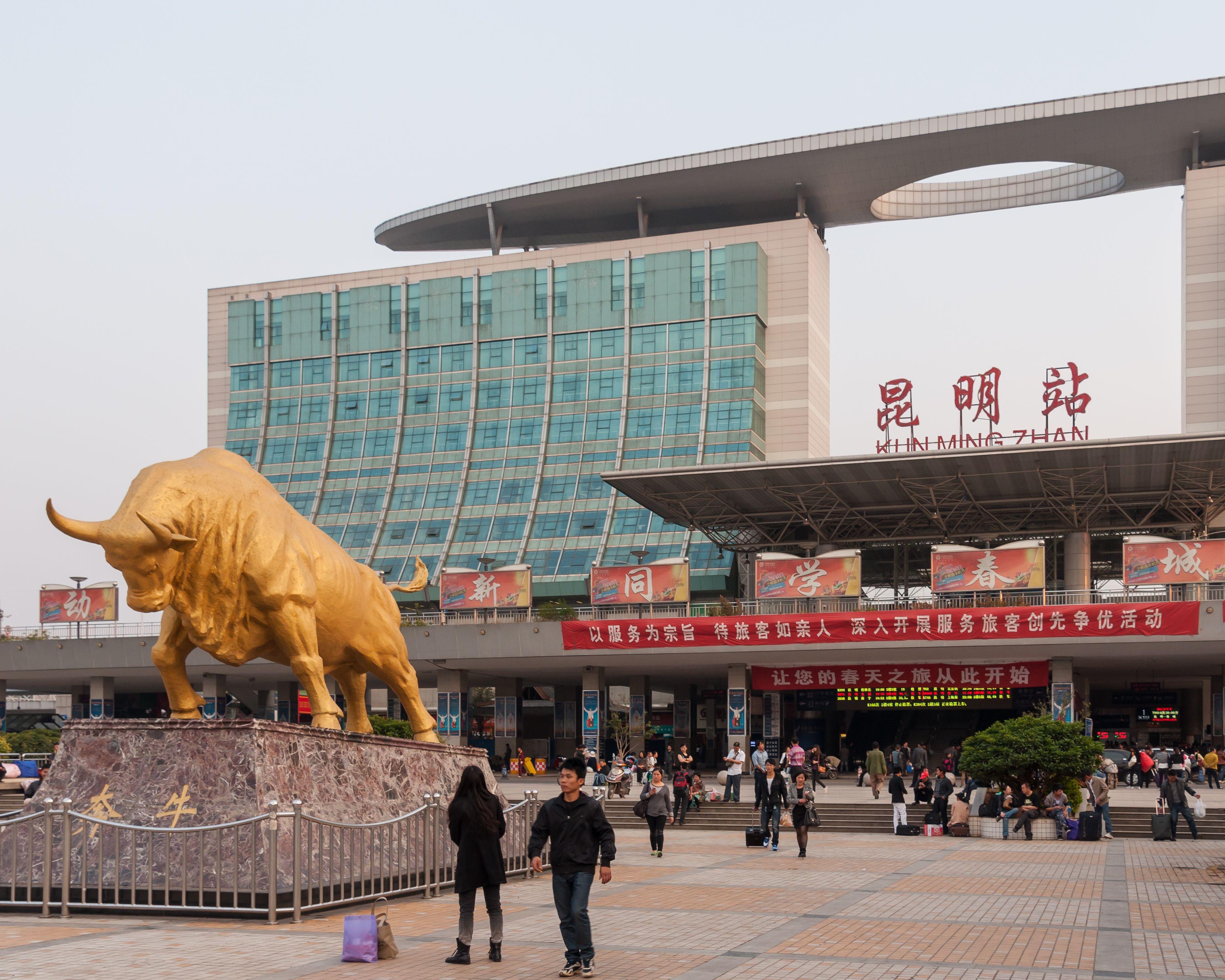
The Attack in the Station
On the evening of 1 March 2014 a group armed with long knives attacked travellers waiting for trains and buying tickets at Kunming railway station in Yunnan. The court later found that at about 21:12 five attackers moved from the station’s temporary waiting area through the forecourt, the second ticketing area, the ticket hall and the left-luggage office, cutting people down as they went and displaying flags they had made in advance. Police arrived and opened fire, killing four of them at the scene and wounding and capturing a woman. Later reports said the attack lasted nearly 25 minutes.
Xinhua reporters interviewed survivors at the scene and in hospital that night. A couple said that at about 21:00 the crowd in front of the bronze bull on the station square suddenly broke into chaos, with people screaming and scattering. Yang Haifei, who was at a ticket window buying a ticket to go and find work elsewhere, said a group rushed in hacking at anyone they saw and one attacker came straight at him with a long knife. Among the dead was Xiong Wenguang, born in 1955 in Chuxiong, Yunnan, who with his wife Chen Guizhen had planned to spend the night in the temporary waiting room and take an early train to work in Zhejiang. Chen told reporters: “We are honest, simple farmers. Why are these people so ruthless?”
Some people fought back. A year later the Yunnan Foundation for Courageous Deeds disclosed that 18 people had been recognised as heroes for fighting the attackers. The three whose names were made public were all security guards who were killed—Li Bin, Zu Chaowen and Zhang Jianguang; the other 15 were not named to protect them and their families. Bus and taxi drivers near the station helped 75 of the wounded that night.
Casualties
The figures released in the following days kept changing: Xinhua reported 28 dead and 113 injured as of 01:00 on 2 March; a bulletin that morning gave 29 dead and more than 130 injured; twelve medical institutions in Kunming treated 143 injured, 73 of them seriously. The court ultimately found that the attack killed 31 people and injured 141, 40 of them seriously. The four attackers shot dead at the scene are not included in the death toll.
The Central Response and a Case “Solved in 40 Hours”
After the attack Xi Jinping issued instructions to “punish the violent terrorists severely in accordance with the law and resolutely crush their arrogance”, and dispatched Meng Jianzhu, secretary of the Central Political and Legal Affairs Commission, and Guo Shengkun, State Councillor and Minister of Public Security, to Yunnan overnight; Premier Li Keqiang ordered the swift pursuit of the attackers and stronger precautions in crowded public places. Meng’s working group arrived in Kunming at 05:30 on 2 March. Xinhua reported on 2 March that evidence at the scene showed it was “a serious violent terrorist incident planned and organised by Xinjiang separatist forces”.
On the evening of 3 March the Ministry of Public Security announced that after more than 40 hours of investigation by public security organs from Yunnan, Xinjiang and the railways, the case had been solved that afternoon. It said the attack was carried out by a gang headed by Abdurehim Kurban, made up of eight people (six men and two women): four were shot dead, a woman was wounded and captured, and “the other three have been caught”. Early reports had given varying numbers of attackers, including “more than ten”. The verdict six months later showed that the other three had been arrested in Shadian, Yunnan, on 27 February—before the attack—on suspicion of illegally crossing the border, and that the court regarded one of them, Iskandar Ahat, as the group’s leader, rather than Kurban, who was among the four shot dead at the scene.
Trial and Executions
On 12 September 2014 the Kunming Intermediate People’s Court delivered its first-instance verdict. It found that since December 2013 the defendants, the four attackers who were killed and five others had gathered in Guangzhou, Zhuhai, Nanyang, Lanzhou, Jinghong and Shadian in Gejiu in order to leave the country illegally and carry out violent terrorist activities, choosing leaders, doing physical training and buying knives, and had gradually formed a terrorist organisation headed by Iskandar Ahat; members were repeatedly shown audio and video of bomb-making and of foreign terrorists training and carrying out attacks. The court found that they had been influenced by religious extremism.
According to the court, having failed to leave the country, the eight met repeatedly at a barber shop in Shadian from 24 to 26 February and plotted a knife attack at Kunming or Gejiu railway station; they bought more than ten long and short knives and made a blue flag of the “ETIM” and a black “jihad” flag. After Iskandar Ahat and two others were arrested on 27 February, the remaining five, unable to contact them at noon on 1 March, decided to carry out the plan that day; they left Shadian in a hired car at about 17:30 and reached Kunming station at about 20:30.
The court sentenced Iskandar Ahat, Turgun Tohtunyaz and Yusup Mamat to death for organising and leading a terrorist organisation and intentional homicide, holding that after their arrest they had refused to confess although they knew their accomplices were about to kill, and so bore responsibility for all the organisation’s crimes. Patigul Tohti was sentenced to life imprisonment for joining a terrorist organisation and intentional homicide; the court called her crimes extremely serious but said that because she was pregnant in custody the death penalty could not lawfully be applied. The court provided interpreters and appointed defence lawyers for the defendants. On 31 October the Yunnan High People’s Court rejected Yusup Mamat’s appeal—he argued that he had not carried out any killing and was not guilty of homicide—and upheld the verdict. On 24 March 2015, with the approval of the Supreme People’s Court, the three were executed.
International Reactions and the Dispute over “Terrorism”
On 2 March the UN Security Council issued a press statement condemning the terrorist attack “in the strongest terms”; Secretary-General Ban Ki-moon issued a statement of condemnation, and Russian President Vladimir Putin sent condolences to Xi Jinping. At the State Department briefing on 3 March a Phoenix TV reporter asked why the US Embassy’s statement on the first day had not described it as a terror attack. Spokeswoman Jen Psaki said that based on information reported by the Chinese media, it “appears to be an act of terrorism targeting random members of the public”—“So we are calling this an act of terrorism”—but that the United States had no independent information about the identity or motivation of the attackers.
Chinese official media criticised some Western coverage. Beijing Review noted that CNN had put the word “terrorists” in quotation marks; on 3 March the All-China Journalists Association said some outlets were calling the knife-wielders attackers or activists rather than terrorists, which it called “double standards”. On 4 March Fu Ying, spokeswoman for the National People’s Congress session, called for more international understanding and support for China’s fight against terrorism.
Debate over Motives and Consequences
The Chinese authorities characterised the attack as a violent terrorist incident organised by Xinjiang separatist forces, and the court found that the attackers had been influenced by religious extremism. Jacob Zenn, an analyst with the Jamestown Foundation in the United States, suggested that the attack may have been linked to the arrest of dozens of Uyghurs on the Yunnan–Laos border in 2013 and that revenge may have been the foremost motive; he noted that targeting a public place such as a train station, and the presence of women among the attackers, were unusual in Uyghur militancy. Less than two weeks after the attack the Uyghur-led Turkistan Islamic Party released a video praising it, without claiming direct responsibility.
James Leibold of La Trobe University in Australia observed that Uyghur grievances had previously been aimed chiefly at symbols of the state such as police stations and government buildings, whereas this time ordinary citizens were targeted, marking a spread of interethnic violence beyond Xinjiang. He also noted that the State Council Information Office ordered media to adhere strictly to Xinhua copy or information from local authorities, avoid large headlines and not publish grisly photos, and that the authorities arrested 45 people for spreading rumours online and “provoking panic”. In his view the government feared that open discussion could inflame ethnic hostility; he expected tighter surveillance of Uyghur communities outside Xinjiang and noted that a new anti-terror law was on the legislative agenda.
Gallery
Narrative Comparison
| Source | Narrative |
|---|---|
| Xi Jinping’s instructions and the Ministry of Public Security announcement as reported by China News Service; Kunming Intermediate and Yunnan High Court rulings | The Chinese authorities characterised the incident as “a serious violent terrorist incident planned and organised by Xinjiang separatist forces”, and Xi Jinping called for the attackers to be punished severely and their arrogance crushed. The courts found that the attackers, influenced by religious extremism, had formed a terrorist organisation headed by Iskandar Ahat in order to leave the country illegally and carry out attacks, and had made “ETIM” and “jihad” flags; the leaders, though arrested before the attack, refused to confess and bore responsibility for all its crimes. Officials stressed that the defendants had interpreters and defence lawyers, and criticised some Western media for avoiding the word “terrorists” as “double standards”. |
| State Department spokeswoman Jen Psaki, daily press briefing (3 March 2014) | The State Department extended condolences and said it opposed terrorism in all its forms. Spokeswoman Jen Psaki said that based on the information reported by the Chinese media “this appears to be an act of terrorism targeting random members of the public. … So we are calling this an act of terrorism”; but she added that the United States had no independent information about the identity or the motivation of the attackers and so would not comment on China’s conclusion that Xinjiang separatists were responsible. Asked why the US Embassy’s first-day statement had not called it a terror attack, she said the US looked at each situation separately, depending on the information available. |
| James Leibold (La Trobe University), Inside Story (March 2014) | Leibold argues that the attack marked “a significant seepage of interethnic violence outside the XUAR”: Uyghur indignation had previously been aimed at police stations, government buildings and security forces, but here ordinary citizens were targeted. He focuses on the government’s control of information—the State Council Information Office ordered media to follow Xinhua copy and not publish grisly photos, and 45 people were arrested for spreading rumours and “provoking panic”—and argues that the government feared open discussion could inflame racist sentiment, predicting “even more intense surveillance of the small and beleaguered Uyghur communities living outside the XUAR”. |
| Survivors interviewed by Xinhua reporters (2 March 2014) | Survivors described the chaos as the attack began. He Guodong, who was buying a ticket in the ticket hall, said: “I only heard someone shout ‘They’re stabbing people!’ and suddenly there was chaos”. Yang Haifei, on his way to find work, said a group rushed in hacking at anyone they saw and one attacker came at him with a long knife. Chen Guizhen, whose husband Xiong Wenguang was killed, said they had bought tickets for the next morning to go to work in Zhejiang and were spending the night in the temporary waiting room: “We are honest, simple farmers. Why are these people so ruthless?” |
Key Milestones
- The group begins to gather
According to the court, eight people and five others gather in Guangzhou, Nanyang, Lanzhou, Shadian and elsewhere to leave the country illegally and carry out attacks.
- Plotting in a Shadian barber shop
From 24 to 26 February the eight plot a knife attack at Kunming or Gejiu station and buy more than ten knives.
- Three arrested in Shadian
Iskandar Ahat and two others are arrested for illegally crossing the border and do not reveal the planned attack.
- Attack at Kunming station
At about 21:12 five attackers kill 31 people and injure 141; four are shot dead and one is wounded and captured.
- Central team arrives; UN condemns
Meng Jianzhu’s working group reaches Kunming; the UN Security Council condemns the attack.
- Case declared solved; US calls it terrorism
The Ministry of Public Security says the case is solved after 40 hours; the State Department calls the attack an act of terrorism.
- First-instance verdict
The Kunming Intermediate Court sentences three to death and Patigul Tohti to life imprisonment.
- Appeal rejected
The Yunnan High Court rejects Yusup Mamat’s appeal.
- Three executed
With Supreme People’s Court approval, Iskandar Ahat and two others are executed.
Last verified:
Cite this page
Chronicles of Modern China. (2026, November 16). Kunming Railway Station Attack (2014). Retrieved November 16, 2026, from https://www.cmcarchive.org/events/kunming-railway-station-attack-2014
“Kunming Railway Station Attack (2014).” Chronicles of Modern China. Last modified November 16, 2026. Accessed November 16, 2026. https://www.cmcarchive.org/events/kunming-railway-station-attack-2014.
Chronicles of Modern China. Kunming Railway Station Attack (2014)[EB/OL]. (2026-11-16)[2026-11-16]. https://www.cmcarchive.org/events/kunming-railway-station-attack-2014.