Hainan Island Incident (2001)
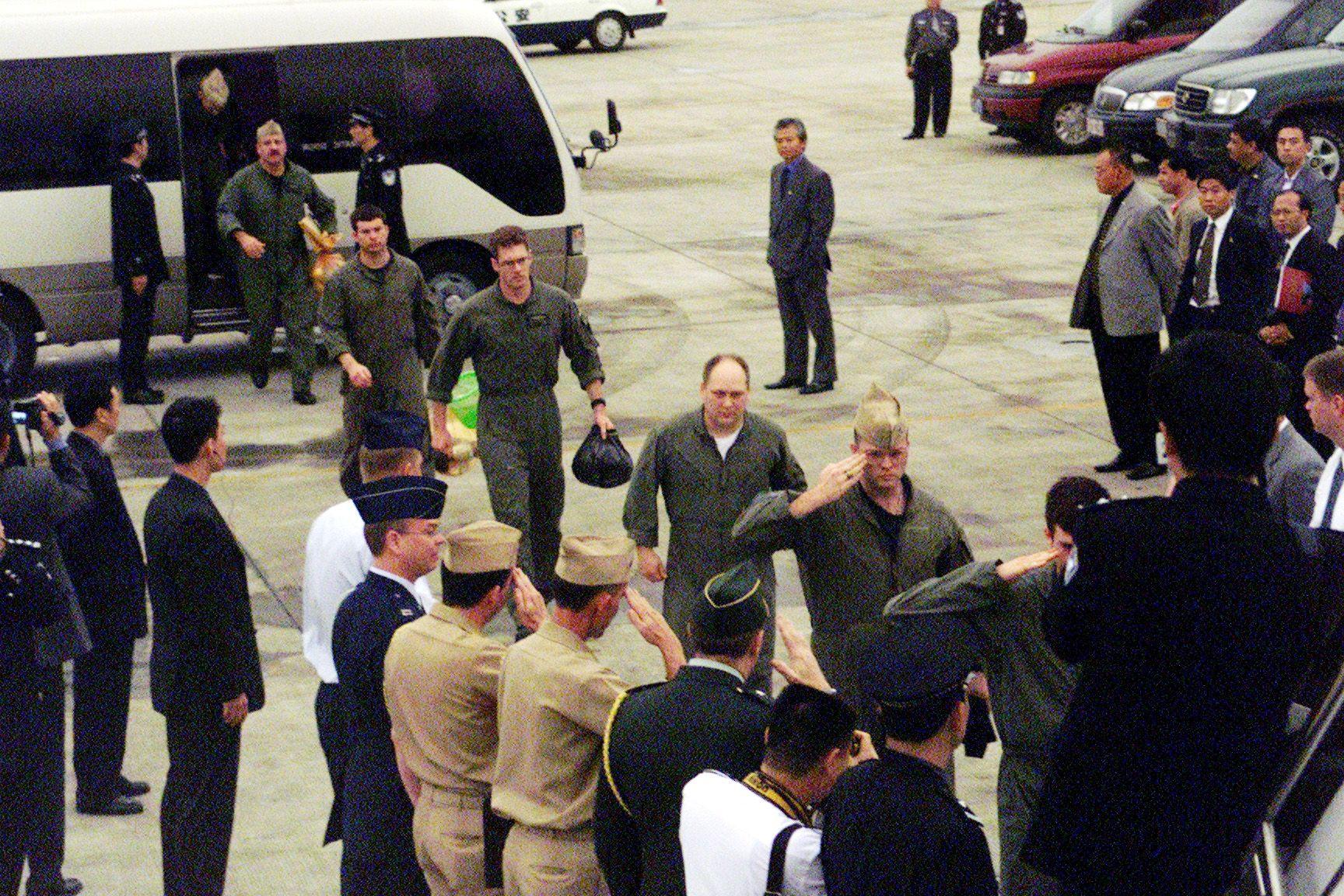
On 1 April 2001 a US Navy EP-3 reconnaissance aircraft collided over the sea southeast of Hainan Island with a Chinese navy J-8 fighter that was tracking it. The Chinese pilot, Wang Wei, bailed out and was lost; the EP-3 made an unauthorised emergency landing at Lingshui airfield on Hainan, and its 24 crew were held for 11 days. China said the US aircraft turned into and destroyed the fighter, put full responsibility on Washington and demanded an apology; the US said the EP-3 was on autopilot flying straight and level when the fighter hit it during a close pass. On 11 April Ambassador Joseph Prueher delivered a letter saying the US was “very sorry” for Wang Wei’s loss and for entering Chinese airspace and landing without verbal clearance, after which China let the crew leave. Wang Wei was named “Guardian of Sea and Sky.” The EP-3 was later dismantled and flown home, while the two sides continued to dispute costs and the legality of the reconnaissance flights.
Background: Close-in Reconnaissance and Interceptions
US military aircraft had long conducted reconnaissance in international airspace off China’s coast, and Chinese naval aviation tracked and monitored them. According to a Congressional Research Service (CRS) report, Defense Secretary Donald Rumsfeld revealed on 13 April 2001 that since December 2000 there had been 44 PLA interceptions of US reconnaissance flights off China’s coast, “with six coming within 30 feet, and two within 10 feet.” China held that US reconnaissance against China and its flight patterns had long gone beyond mere overflight and that Chinese military surveillance over its exclusive economic zone was legitimate.
The Collision on 1 April
According to Foreign Ministry spokesman Zhu Bangzao on 3 April, at 8:36 on 1 April a US Navy EP-3 electronic reconnaissance aircraft approached the waters off Sanya, Hainan, and the Chinese navy sent two J-8 fighters to track it. At 9:07, with the Chinese aircraft 104 km from the territorial sea baseline and the US aircraft flying in the same direction 400 metres to their right, the US aircraft suddenly turned sharply toward them, its nose and left wing striking the tail of one Chinese fighter, which lost control and crashed into the sea; the pilot, Wang Wei, bailed out. The other Chinese fighter landed at 9:23; the US aircraft landed without permission at Lingshui airfield on Hainan at 9:33, and its 24 crew were accommodated by the Chinese side. The PLA Daily reported that the flight leader, Zhao Yu, watched Wang’s aircraft fall and ordered him to bail out.
The US account was the reverse. According to the CRS report, Rumsfeld said “the EP-3 was on autopilot and flying straight and level, when the F-8 fighter hit the U.S. plane, and it plunged 5,000 to 8,000 feet before the crew got it under control”; the collision came on the fighter’s third pass, and on a previous pass it had come within an estimated three to five feet. The CRS assessment concluded that the PLA pilot, “executing a close pass in an apparent attempt to impress or intimidate the EP-3 crew, made a fatal error in judgment.” Darryl Johnson, then a deputy assistant secretary in the State Department’s East Asia bureau, recalls that once the plane was stabilized the crew damaged most of its monitoring equipment, and that the US was never able to establish whether its emergency landing notice had been received.
Eleven Days of Negotiation and the Letter
China protested to the United States on the day of the collision; US officials were not allowed to see the crew until the evening of 3 April. On 4 April Foreign Minister Tang Jiaxuan summoned Ambassador Joseph Prueher, saying responsibility lay entirely with the United States, that the US aircraft had violated the UN Convention on the Law of the Sea, and that the US should bear full responsibility and apologise. Zhu said President Jiang Zemin had repeatedly ordered that no cost be spared in searching for Wang Wei. Washington initially would not apologise and offered only regret; Johnson recalls that Secretary of State Colin Powell insisted it was an “accident,” not an “incident,” since China had not intended to knock down the plane.
On 11 April Prueher delivered a letter to Tang. It said that President Bush and Secretary Powell had expressed sincere regret over the missing pilot and aircraft, asked that the Chinese people and Wang Wei’s family be told “that we are very sorry for their loss,” and said “We are very sorry the entering of China's airspace and the landing did not have verbal clearance”; it agreed to a meeting from 18 April on the causes of the incident, avoiding future collisions, the return of the EP-3 and China’s concerns about US reconnaissance. China called it a letter of apology—Chen Ci, director of Hainan’s foreign affairs office, rendered its wording as “deep apologies”—and announced that the crew would be allowed to leave on humanitarian grounds, while saying the incident was not over. Johnson calls it what Powell termed “the letter of the two sorries,” adding: “But that was as far as we were prepared to go.” On 12 April the 24 crew members left Hainan for Guam.
Xinhua reported on 16 April that CMC Chairman Jiang Zemin had signed an order conferring the title “Guardian of Sea and Sky” on Wang Wei; the order said the US aircraft had violated flight rules and destroyed Wang’s fighter, and that Wang had bailed out on his leader’s order and, despite an all-out search, had died a heroic death.
Aftermath and Legal Disputes
At talks in Beijing on 18–19 April China did not agree to return the EP-3. The US later dismantled the aircraft, and a Russian-built AN-124 flew its fuselage out on 3 July. According to CRS, on 30 June China billed the United States about $1 million in what US officials called “highly exaggerated” charges; in August the Pentagon announced a payment of $34,567, which China rejected as “unacceptable.” CRS described the incident as the third in a series of major troubling difficulties in US–China relations since the mid-1990s.
The legal positions were sharply opposed. China argued that the reconnaissance violated the Law of the Sea Convention’s requirement to respect coastal-state rights when flying over an exclusive economic zone, and that entering Chinese airspace and landing without permission violated Chinese sovereignty, so that as an illegal entrant the aircraft enjoyed no immunity. Frederic Kirgis of Washington and Lee University, writing for the American Society of International Law, argued that flying beyond the 12-mile territorial sea did not amount to flying over Chinese territory; that aircraft in distress probably enjoy a right of entry analogous to ships in distress; that surveillance, though “regarded by observed countries as an unfriendly act,” is not an armed attack justifying force; and that the US had “a reasonably strong claim” to sovereign immunity for the aircraft, depending on whether its landing qualified as permissible entry in distress.
Gallery
Narrative Comparison
| Source | Narrative |
|---|---|
| Foreign Ministry spokesman Zhu Bangzao (3 April 2001); Foreign Minister Tang Jiaxuan’s summons of Ambassador Prueher (4 April 2001); CMC order honouring Wang Wei (April 2001) | China’s position is that the US aircraft, flying alongside to the right of the Chinese fighters, suddenly turned sharply toward them and destroyed one—proved, it says, by the EP-3’s detached nose and deformed left propeller; that US reconnaissance against China abused the principle of freedom of overflight and violated the Law of the Sea Convention and the May 2000 US–China consensus on avoiding dangerous military activities at sea; and that the aircraft’s unauthorised entry and landing infringed Chinese sovereignty, leaving “no question of immunity.” Responsibility therefore lay entirely with the US, which should apologise and stop reconnaissance off China’s coast. The CMC order says Wang Wei died on a monitoring mission because the US aircraft violated flight rules, and names him “Guardian of Sea and Sky”. |
| Ambassador Prueher’s letter to Foreign Minister Tang (11 April 2001); CRS Report RL30946 (2001) | The US view is that the EP-3 was on autopilot flying straight and level when the Chinese fighter, making a close pass, hit it; CRS judged that the PLA pilot, “executing a close pass in an apparent attempt to impress or intimidate the EP-3 crew, made a fatal error in judgment,” stressing that “all aircraft have a right of overflight with respect to ocean areas beyond the territorial sea.” Washington pointed to a pattern of dangerous PLA interceptions beforehand. The letter said the US was “very sorry” for Wang Wei’s family’s loss and that the entry and landing lacked verbal clearance, but described an emergency landing “after following international emergency procedures” and did not accept responsibility for the collision. |
| Frederic L. Kirgis, ASIL Insights (2001) | Kirgis analyses the case under international law: beyond the 12-mile territorial sea the aircraft was not flying over Chinese territory even within a Chinese-claimed air defence zone; the exact nature of China’s claim over the area “is unclear, and in any event it appears not to have been recognized by other governments”; and surveillance, though unfriendly, “is not an armed attack or an act of aggression that would trigger a right of self defense.” The landing without verbal clearance was made in distress, and aircraft in distress probably enjoy a right of entry like ships; the US has “a reasonably strong claim” to sovereign immunity, but since China asserts the aircraft had no right to be there, the question turns on whether the landing was a permissible entry in distress. |
| Darryl Johnson (then Deputy Assistant Secretary of State for East Asian and Pacific Affairs), ADST oral history | Johnson, a State Department official who handled the crisis, recalls that the EP-3 was put on autopilot when the PLA fighters appeared, “so that the plane would not make any unexpected moves that could be misinterpreted,” and believes the Chinese pilot “got so close, and slowed down so much that he actually [lost lift and] stalled under the left wing.” He records Prueher telling the Chinese that “It is impossible for a slower aircraft to overtake a faster aircraft,” and admits the US could never establish whether its emergency notice was received. Washington was “not prepared to apologize” but could “regret” the incident, producing what Powell called “the letter of the two sorries”: “But that was as far as we were prepared to go.” |
Key Milestones
- US protests interceptions
According to CRS, the US formally protests dangerous PLA interceptions of its reconnaissance aircraft.
- Collision over the South China Sea
A US EP-3 and a Chinese J-8 collide southeast of Hainan; pilot Wang Wei bails out and is lost, and the EP-3 lands at Lingshui.
- US officials see the crew
US officials are allowed to meet the detained crew.
- Tang summons Prueher
Tang Jiaxuan says responsibility lies entirely with the US and demands an apology.
- US letter delivered
Prueher delivers a letter saying “very sorry” twice; China announces the crew may leave.
- Crew leaves Hainan
The 24 US crew members fly from Hainan to Guam.
- Wang Wei named “Guardian of Sea and Sky”
Xinhua reports Jiang Zemin’s order conferring the title on Wang Wei.
- Talks in Beijing
US–China talks open in Beijing; China does not agree to return the EP-3.
- EP-3 fuselage flown out
The dismantled EP-3’s fuselage is flown out of China on an AN-124.
- US announces payment
The Pentagon announces a payment of $34,567, which China rejects.
Last verified:
Cite this page
Chronicles of Modern China. (2026, November 11). Hainan Island Incident (2001). Retrieved November 11, 2026, from https://www.cmcarchive.org/events/hainan-island-incident-2001
“Hainan Island Incident (2001).” Chronicles of Modern China. Last modified November 11, 2026. Accessed November 11, 2026. https://www.cmcarchive.org/events/hainan-island-incident-2001.
Chronicles of Modern China. Hainan Island Incident (2001)[EB/OL]. (2026-11-11)[2026-11-11]. https://www.cmcarchive.org/events/hainan-island-incident-2001.