Gold Yuan Currency Reform (1948)
On 19 August 1948 the Nationalist government issued the Emergency Decree on Finance and Economy, introducing the gold yuan at three million fabi to one, freezing prices and wages and compelling the surrender of privately held gold, silver and foreign currency. Chiang Ching-kuo enforced controls in Shanghai with an iron hand, detaining figures such as Rong Hongyuan and Du Weiping, but was checked after sealing David Kung’s Yangtze Corporation, when Soong Mei-ling and Chiang Kai-shek intervened. Price controls produced shortages and panic buying; on 1 November they were lifted, Premier Wong Wen-hao resigned and Chiang Ching-kuo stepped down; in mid-November owning gold was legalised again and the government began selling it. The gold yuan then collapsed. Mainland media see the episode as a portrait of the Nationalists’ economic collapse, the US Embassy concluded that it pauperised the middle class, and Taiwan’s official encyclopedia records its impact on Taiwan’s hyperinflation.
The Collapse of the Fabi
After the war against Japan, the Nationalist government kept printing fabi to fund the civil war. By August 1948 the amount in circulation was more than 470,000 times that of June 1937. According to an article in The Paper’s Private History section, 100 yuan of fabi bought a sixth of a bar of soap in 1946, one coal briquette in 1947, and 0.002416 liang of rice on 19 August 1948; in June 1948 a university teacher’s monthly salary had “risen” to 5 million yuan, enough for half a dan of rice. A US Embassy report records that in January 1948 one US dollar fetched about 140,000 fabi on the Shanghai black market; the currency then slid continuously, until by August exports had all but stopped and transactions required bundles of notes.
The 19 August Currency Reform
On 19 August 1948 Chiang Kai-shek issued the Emergency Decree on Finance and Economy and related regulations, replacing the fabi with the gold yuan. According to the US Embassy, fabi were converted at three million to one gold yuan, and the gold yuan was pegged at four to the US dollar; the announced reserve was 40 per cent gold, silver and foreign exchange and 60 per cent government-owned shares in state enterprises, and total issue was capped at 2 billion. Prices and wages everywhere were frozen at their 19 August levels, hoarding and strikes were banned, and privately held gold, silver and foreign currency had to be exchanged for gold yuan at the Central Bank by set deadlines.
The Embassy attributed the plan mainly to Premier Wong Wen-hao, Finance Minister Wang Yun-wu and Vice Minister Hsu Po-yuan; the original scheme had made the gold yuan convertible into gold at a fixed rate, a provision Chiang Kai-shek struck out. On 23 August Ambassador John Leighton Stuart cabled that the Embassy could “find no basis for optimism regarding gold yuan’s future”, that the programme could at most buy three or four months’ respite from rising prices, and that the announced $200 million reserve in gold, silver and foreign exchange “does not in fact exist in that amount”. The Paper’s article describes the gold yuan as having “no reserve at all”.
Chiang Ching-kuo’s “Tiger Hunt” in Shanghai
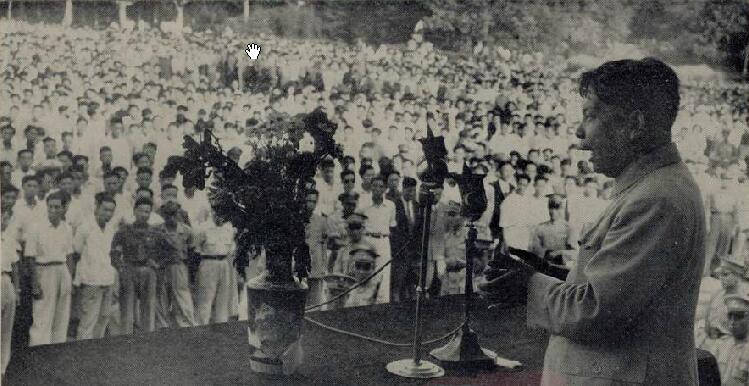
On 20 August the Executive Yuan set up an Economic Control Commission with supervisory districts in Shanghai, Tianjin and Guangzhou. In Shanghai O. K. Yui was supervisor and Chiang Ching-kuo his assistant, though according to the historian Yang Tianshi Chiang Ching-kuo bore full responsibility. He brought in the Defence Ministry’s Bandit-Suppression and National Reconstruction Corps as his core staff, set up “people’s service stations” with denunciation boxes on 29 August, and detained figures such as Rong Hongyuan, general manager of the Shenxin textile company, and Du Weiping, son of Du Yuesheng, handing them to the courts. After Chiang Ching-kuo reported in Nanjing on 7 September, Chiang Kai-shek wrote in his diary that “most of the black-market and hoarding abuses were led by our own Party and government officials—painful to say”. On 25 September the Greater Shanghai Youth Service Corps was founded; 25,428 applied and 12,339 were accepted. The US Embassy later observed that Chiang Ching-kuo “attacked enforcement more as a social crusade than as a problem needing economic sophistication”.
The Yangtze Corporation Case
On 30 September the Shanghai authorities sealed large stocks of goods in the warehouses of the Yangtze Development Corporation, run by Kung Ling-kan (David Kung), son of H. H. Kung and Soong Ai-ling. Yang Tianshi cites the recollection of economic inspection chief Cheng Yikuan that the search was prompted by Du Yuesheng, who at a meeting of businessmen called by Chiang Ching-kuo asked that the Yangtze company be treated the same as everyone else. On 1 October Soong Mei-ling flew to Shanghai. According to the recollection of Chiang Ching-kuo’s aide Jia Yibin, cited by Yang Tianshi, she summoned Chiang Ching-kuo and Kung Ling-kan to mediate between them and, failing, telephoned Chiang Kai-shek in Beiping urging him to come south at once; on 8 October Chiang Kai-shek, then directing the Manchurian campaign from Beiping, suddenly flew to Shanghai and soon ordered the suspension of the Dazhong Evening News, which had reported the case; the next morning Soong Mei-ling personally drove Kung Ling-kan to the residence to see Chiang Kai-shek. On 9 October Chiang Ching-kuo wrote in his diary: “Legally, the Yangtze Corporation can stand”, since the company had registered its goods beforehand. On 18 October Chiang Kai-shek cabled Shanghai mayor K. C. Wu that the Control Yuan’s plan to investigate the company was “quite unreasonable” and that the Yuan “should not make trouble for commercial enterprises”. Yang Tianshi regards this as in effect blocking the investigation.
The Collapse of Price Controls and Chiang Ching-kuo’s Resignation
Price controls led merchants to withhold goods, which moved onto the black market. On 24 October Chiang Kai-shek wrote: “The situation worsens daily; shops are empty while goods are hidden, people queue to scramble for goods, and food shortages are most worrying.” According to the US Embassy, by mid-October the gold yuan had lost 80 per cent of its value against the dollar. On 1 November the Executive Yuan lifted price controls and Premier Wong Wen-hao took responsibility for the failure and resigned. The same day Chiang Ching-kuo issued a letter to the people of Shanghai admitting that he had failed in his task and had “added to the people’s suffering”, and asked to be punished; on 6 November he resigned as supervisor. On 8 November Chiang Kai-shek wrote that since controls were lifted Shanghai prices had “actually risen four- or five-fold”.
The new finance minister, Hsu Kan, then reversed the reform’s rules on precious metals: from 11 November owning gold and silver was no longer illegal, and from 22 November the public could buy gold from the government at GY 1,000 an ounce plus a further GY 1,000 deposit. US Consul General John Cabot in Shanghai noted that those who had been forced to sell their gold to the government for GY 200 an ounce now had to pay GY 2,000 to buy the same ounce back.
Consequences and Assessments
The gold yuan’s depreciation then accelerated. According to The Paper, it lost value faster in its ten months than the fabi had in fourteen years; on the eve of Shanghai’s fall Gu Jiegang noted in his diary that tofu cost 200,000 a square in the morning and 300,000 by evening; and in May 1949 the northwest commander Zhang Zhizhong reported that troops had returned their gold yuan pay unopened because markets refused it. The US Embassy calculated that one US dollar cost 150,000 fabi at the start of 1948 and the equivalent of more than 400 million by the end. In Taiwan, according to the Encyclopedia of Taiwan published by Taiwan’s Ministry of Culture, the gold yuan’s initial fixed rate with the Taiwan dollar drew a flood of mainland flight capital and sharply accelerated the island’s hyperinflation, until on 15 June 1949 the Taiwan provincial government issued the New Taiwan dollar and cut the link with the mainland’s monetary economy.
Explanations of the failure differ in emphasis. The US Embassy’s report of early 1949 concluded that the net result was to legitimise the position of the rich who had never turned in their hoards and to pauperise the fledgling middle class that had faithfully surrendered its gold. The economist Liang Xiaomin argues that war needs made it impossible to control money issuance, and that the urban middle classes, having handed over their gold and foreign currency, saw their savings wiped out and lost faith in the Nationalists. The American historian Parks M. Coble points out that Chiang Kai-shek, focused on military matters, put off introducing a new currency until it was too late.
Gallery
Narrative Comparison
| Source | Narrative |
|---|---|
| The Paper, Private History (2017); interview with economist Liang Xiaomin (reprinted by The Paper, 2014) | Mainland media present the gold yuan reform as an economic portrait of the Nationalist regime’s collapse in the civil war: a “desperate effort” to save itself by issuing a currency with “no reserve at all”, whose credibility was destroyed by military defeat and huge deficits, so that it lost value faster in ten months than the fabi had in fourteen years. The economist Liang Xiaomin argues that the urban middle classes, having handed over nearly all their gold and foreign currency, saw their savings wiped out by the hyperinflation and lost confidence in the regime. The hyperinflation is also seen as one of the “negative assets” the Nationalists left the new People’s Republic. |
| Taiwan Ministry of Culture, Encyclopedia of Taiwan, “Hyperinflation” (by Li Wei-chen) | Taiwan’s official encyclopedia views the gold yuan mainly through Taiwan’s own experience: the Taiwan dollar had been kept at a fixed rate with the mainland fabi, and the gold yuan initially kept that fixed rate, so mainland flight capital poured into Taiwan; a floating adjustment after November could not stop it, and Taiwan’s hyperinflation accelerated sharply from late 1948. Only when the provincial government issued the New Taiwan dollar on 15 June 1949, severing the link with the mainland monetary economy, did prices stabilise for a time. |
| Ambassador Stuart’s telegram (23 August 1948); US Embassy report (4 January 1949); Consul General Cabot’s airgram (24 November 1948) | American diplomats doubted the reform from the start. Four days in, Stuart cabled that the Embassy could “find no basis for optimism regarding gold yuan’s future”: the deficit remained and the announced reserve fell short. The Embassy’s later review held that the government used its brief breathing space neither to cut the deficit nor to win a military victory, and that Chiang Ching-kuo “attacked enforcement more as a social crusade than as a problem needing economic sophistication”. The net result, it concluded, was to legitimise the rich and pauperise the middle class that had faithfully turned in its gold, costing the government the support of those who had most to fear from Communism. |
| Parks M. Coble, The Collapse of Nationalist China, chapter 6 summary (Cambridge University Press, 2023) | The American historian Parks M. Coble places the reform within Chiang Kai-shek’s overall style of rule: Chiang turned to his son, who began “a reign of terror in Shanghai”, alienated major capitalists and bankers, and created a family crisis by pursuing David Kung; Chiang Ching-kuo could not hold prices, and when controls were abandoned in early November hyperinflation exploded. Chiang’s focus on military issues, Coble argues, led him to put off a new currency until it was too late, and capitalists began fleeing to Hong Kong, America and elsewhere. |
| Diaries of Chiang Kai-shek and Chiang Ching-kuo (as cited by Yang Tianshi); Gu Jiegang’s diary (as cited by The Paper) | The protagonists’ diaries trace the reform from hope to disillusion. In September Chiang Kai-shek, after hearing his son’s report, wrote that “most of the black-market and hoarding abuses were led by our own Party and government officials—painful to say”, while welcoming the investigation; after the Yangtze case broke, Chiang Ching-kuo conceded that “Legally, the Yangtze Corporation can stand”; in late October Chiang Kai-shek wrote: “The situation worsens daily; shops are empty while goods are hidden, people queue to scramble for goods”; after controls were lifted he noted that Shanghai prices had “actually risen four- or five-fold”. The next year, on the eve of Shanghai’s fall, the scholar Gu Jiegang wrote: “When I bought tofu it was 200,000 a square; by evening it was 300,000.” |
Key Milestones
- Emergency Decree on Finance and Economy
The gold yuan is introduced at three million fabi to one; prices and wages are frozen at that day’s level.
- Economic Control Commission set up
Supervisory districts are set up in Shanghai, Tianjin and Guangzhou; Chiang Ching-kuo directs controls in Shanghai as assistant supervisor.
- Stuart sees “no basis for optimism”
The US ambassador judges the programme can at most halt rising prices for three or four months.
- Greater Shanghai Youth Service Corps founded
12,339 young people are enrolled to help root out hoarding.
- Yangtze Corporation goods sealed
Goods in the Shanghai warehouses of David Kung’s Yangtze Development Corporation are sealed.
- Chiang Kai-shek flies to Shanghai
Chiang Kai-shek flies in from Beiping; the Dazhong Evening News, which reported the Yangtze case, is then suspended.
- Price controls lifted
The Executive Yuan lifts price controls; Wong Wen-hao resigns and Chiang Ching-kuo issues a letter to the people of Shanghai.
- Chiang Ching-kuo resigns
Chiang Ching-kuo resigns as Shanghai economic control supervisor.
- Gold and silver legalised
Owning gold and silver becomes legal again; from 22 November the government sells gold to the public.
- New Taiwan dollar issued
The Taiwan provincial government issues the New Taiwan dollar, severing the link with the mainland currency.
Last verified:
Cite this page
Chronicles of Modern China. (2026, November 19). Gold Yuan Currency Reform (1948). Retrieved November 19, 2026, from https://www.cmcarchive.org/events/gold-yuan-reform-1948
“Gold Yuan Currency Reform (1948).” Chronicles of Modern China. Last modified November 19, 2026. Accessed November 19, 2026. https://www.cmcarchive.org/events/gold-yuan-reform-1948.
Chronicles of Modern China. Gold Yuan Currency Reform (1948)[EB/OL]. (2026-11-19)[2026-11-19]. https://www.cmcarchive.org/events/gold-yuan-reform-1948.