China Evergrande Debt Crisis
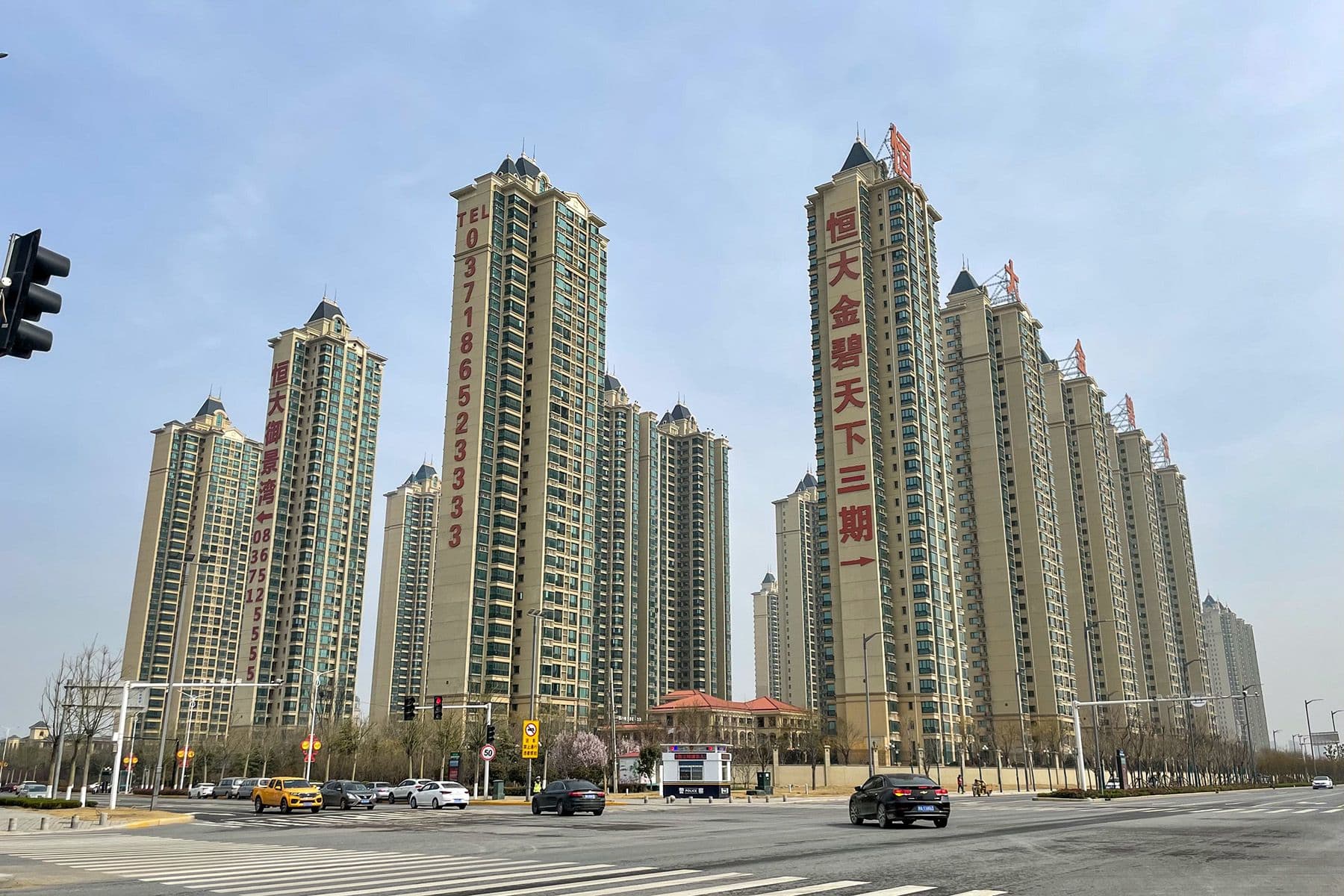
Evergrande, once one of China's largest property developers, ran out of cash under the new "three red lines" financing rules and defaulted on its debt in 2021, becoming the emblem of China's property-sector crisis. After the Guangdong government sent in a working group, Evergrande reported losses of more than RMB 800 billion, was ordered into liquidation by a Hong Kong court in 2024 and delisted in 2025; in 2026 its founder Xu Jiayin was sentenced at first instance to life imprisonment for crimes including fund-raising fraud and fraudulent securities issuance.
Background: Debt-Fuelled Expansion and the "Three Red Lines"
Evergrande was founded by Xu Jiayin (Hui Ka Yan) in Guangzhou in 1996 and listed on the Hong Kong Stock Exchange in 2009. It grew rapidly into one of China's largest property developers and diversified into football, bottled water and electric vehicles, borrowing heavily as it expanded. On 20 August 2020, the Ministry of Housing and Urban-Rural Development and the People's Bank of China held a symposium with key property developers in Beijing, reaffirmed the principle that "housing is for living in, not for speculation", and announced that rules for funding monitoring and financing management of key property developers had been formed. The details were not officially published; according to media reports, the rules constrained the growth of developers' interest-bearing debt through three indicators — the liability-to-asset ratio excluding advance receipts, the net gearing ratio and the cash-to-short-term-debt ratio — known in the industry as the "three red lines", and were first piloted at 12 developers including Evergrande.
2021: The Liquidity Crisis Goes Public
In the second half of 2021, Evergrande's funding problems became public. On 13 September, around 100 investors crowded the lobby of its Shenzhen headquarters demanding repayment of loans and matured wealth management products; according to Caixin, Evergrande proposed that day to repay in instalments or with property, and the company said the same day that online talk of its bankruptcy and restructuring was "totally untrue".
On 15 October, Zou Lan, director of the PBOC's Financial Markets Department, said Evergrande Group's total assets exceeded RMB 2 trillion, that its problems stemmed from poor management and blind diversification, that financial liabilities made up less than a third of its total liabilities, and that the spillover of its risks to the financial sector was controllable. On 20 October, PBOC Governor Yi Gang said that Evergrande's risk was "an isolated case" and that its liabilities were about US$300 billion.
On the evening of 3 December, China Evergrande announced that, given its current liquidity, it was uncertain whether it would have sufficient funds to continue meeting its financial obligations. The Guangdong provincial government summoned Xu Jiayin that evening and, at the request of Evergrande Real Estate Group, agreed to send in a working group to push forward the handling of its risks. A PBOC official said Evergrande's risks had arisen "mainly from its own poor management and blind expansion". On 9 December, the rating agency Fitch cut Evergrande to "restricted default" after the company failed to confirm payment of dollar-bond coupons whose grace period had expired; Evergrande itself did not formally declare a default.
Suspension, Huge Losses and Liquidation
On 21 March 2022, China Evergrande, Evergrande Property Services and Evergrande Auto were suspended from trading in Hong Kong; it was subsequently disclosed that about RMB 13.4 billion of Evergrande Property Services' pledged deposits had been enforced by the banks concerned. With its audits obstructed, Evergrande did not publish its 2021 and 2022 annual results until 17 July 2023: net losses over the two years totalled about RMB 812 billion, and at the end of 2022 its total liabilities stood at RMB 2,437.4 billion, with net assets of about minus RMB 599.1 billion. On 28 September 2023, Evergrande announced that Xu Jiayin had been placed under compulsory measures in accordance with the law on suspicion of criminal offences.
On 29 January 2024, Justice Linda Chan of the Hong Kong High Court granted a creditor's petition and ordered China Evergrande to be wound up, on the grounds that more than two years after defaulting on its offshore debt the company had still been unable to put forward a concrete restructuring plan; she appointed Alvarez & Marsal as liquidators. In May that year the China Securities Regulatory Commission found that Hengda Real Estate had inflated its revenue and profits in 2019–2020 by recognising revenue early, amounting to fraudulent bond issuance; it fined Hengda Real Estate RMB 4.175 billion, fined Xu Jiayin RMB 47 million and banned him from the securities market for life. In August 2025 the liquidators disclosed that creditors had submitted debt claims of about US$45 billion and said a holistic restructuring would prove out of reach; China Evergrande's Hong Kong listing was cancelled on 25 August.
Criminal Verdict
On 20 August 2026, the Shenzhen Intermediate People's Court delivered its first-instance verdict. The court found that between 2016 and 2021 Evergrande Group, Hengda Real Estate and Xu Jiayin had inflated assets and concealed liabilities through sustained, large-scale financial fraud, committing crimes including illegally absorbing public deposits, fund-raising fraud and fraudulent issuance of securities, and had gained control of financial institutions through bribery and other means and illegally diverted credit and insurance funds. Convicted of illegally absorbing public deposits, fund-raising fraud, illegal granting of loans, fraudulent issuance of securities, unlawful disclosure of important information, unit bribery, illegal use of funds and embezzlement, Xu Jiayin was sentenced to life imprisonment, deprived of political rights for life and had all his personal property confiscated; Evergrande Group and Hengda Real Estate were fined RMB 8.82 billion and RMB 7 billion respectively. On the same day, courts in Shenzhen sentenced 56 other people involved, including Zhen Litao and Du Liang, to prison terms ranging from 18 years to one year and ten months.
Gallery
Narrative Comparison
| Source | Narrative |
|---|---|
| Chinese official position (PBOC, Guangdong government, Shenzhen Intermediate People's Court) | Evergrande's risks arose mainly from its own poor management and blind diversification; it is an isolated case in the property sector, and the spillover to the financial sector is controllable. The relevant departments and local governments are handling the risks in accordance with the rule of law and market principles, with priority on delivering homes already sold and protecting buyers' lawful rights. The courts found that Evergrande Group and Xu Jiayin had for years inflated assets and concealed liabilities through large-scale financial fraud, committing crimes including illegal fund-raising, fraudulent securities issuance and bribery, and punished them severely according to law. |
| Western academic analysis (Eswar Prasad, 2021) | Eswar Prasad, a Cornell professor and Brookings senior fellow, argued that the Evergrande crisis was the result of the central government's effort to contain developers' debt and curb speculative property investment, and that Beijing's willingness to let a default happen showed it was sticking to market discipline and ending implicit guarantees for highly leveraged firms. He also argued that the government's conflicting signals — between letting markets work and tightening state control — would fuel uncertainty, and that real market discipline also required better corporate governance, transparency, and accounting and auditing standards. |
| Eyewitnesses (protest at Evergrande's Shenzhen headquarters, September 2021, as reported by Reuters) | On 13 September 2021, investors who had bought Evergrande wealth management products poured into the lobby of its Shenzhen headquarters. One woman confronted Du Liang, general manager of the wealth management arm: "A company as big as yours, how much money has been swindled from ordinary people?" A protester surnamed Wang, who said he worked for Evergrande, said he had invested 100,000 yuan and his relatives about 1 million: "They said repayment would take two years, but there's no real guarantee and I'm worried the company will be bankrupt by the end of the year." |
Key Milestones
- "Three red lines" financing rules formed
The housing ministry and the PBOC held a symposium with key property developers in Beijing and announced rules for funding monitoring and financing management of key developers. According to media reports, Evergrande was among the first 12 developers in the pilot.
- Investors crowd Evergrande's Shenzhen headquarters
Around 100 investors crowded the lobby of Evergrande's Shenzhen headquarters demanding repayment of loans and matured wealth management products; Evergrande called online talk of bankruptcy and restructuring "totally untrue".
- Yi Gang calls Evergrande an isolated case
PBOC Governor Yi Gang said Evergrande's risk was an isolated case and its spillover to the financial sector was controllable, echoing remarks by a central bank official on 15 October.
- Guangdong summons Xu Jiayin and sends a working group
Evergrande announced it was uncertain whether it had sufficient funds to continue meeting its financial obligations; the Guangdong provincial government summoned Xu Jiayin that evening and agreed to send a working group to Evergrande Real Estate Group.
- Fitch downgrades to "restricted default"
Fitch cut Evergrande to "restricted default" after the company failed to confirm payment of dollar-bond coupons whose grace period had expired.
- Three Evergrande companies suspended
China Evergrande, Evergrande Property Services and Evergrande Auto were suspended in Hong Kong; it was then disclosed that about RMB 13.4 billion of Evergrande Property Services' pledged deposits had been enforced by banks.
- Overdue results: two-year net loss of about RMB 812 billion
Evergrande published its 2021 and 2022 results; at the end of 2022 its total liabilities were RMB 2,437.4 billion and its net assets were negative.
- Xu Jiayin placed under compulsory measures
Evergrande announced that Xu Jiayin had been placed under compulsory measures on suspicion of criminal offences, and its shares were suspended.
- Hong Kong High Court orders liquidation
Justice Linda Chan ordered Evergrande wound up because it had been unable to offer a concrete restructuring plan, and appointed Alvarez & Marsal as liquidators.
- China Evergrande delisted
China Evergrande's Hong Kong listing was cancelled after it failed to meet the requirements for resuming trading. The liquidators had disclosed debt claims of about US$45 billion.
- Xu Jiayin sentenced to life at first instance
The Shenzhen Intermediate People's Court sentenced Xu Jiayin to life imprisonment at first instance and fined Evergrande Group and Hengda Real Estate RMB 8.82 billion and RMB 7 billion respectively.
Last verified:
Cite this page
Chronicles of Modern China. (2026, November 2). China Evergrande Debt Crisis. Retrieved November 2, 2026, from https://www.cmcarchive.org/events/evergrande-debt-crisis
“China Evergrande Debt Crisis.” Chronicles of Modern China. Last modified November 2, 2026. Accessed November 2, 2026. https://www.cmcarchive.org/events/evergrande-debt-crisis.
Chronicles of Modern China. China Evergrande Debt Crisis[EB/OL]. (2026-11-02)[2026-11-02]. https://www.cmcarchive.org/events/evergrande-debt-crisis.