Japan’s Purchase of the Diaoyu/Senkaku Islands and the 2012 Anti-Japanese Protests
In April 2012 Tokyo governor Shintaro Ishihara announced a plan to buy three of the Diaoyu/Senkaku Islands. On 10 September the Japanese government decided to buy Uotsuri-jima (Diaoyu Dao), Kita-Kojima and Minami-Kojima from their private owner, and on 11 September the cabinet approved 2.05 billion yen. Tokyo said it was merely a transfer of land ownership within Japanese territory and that “there exists no issue of territorial sovereignty to be resolved”; Beijing called the purchase “entirely illegal and invalid,” announced territorial-sea baselines and sent patrol vessels; Taiwan recalled its envoy to Japan in protest. In mid-September anti-Japanese protests took place in 208 Chinese cities, some turning into arson, vandalism and looting of Japanese businesses, and a Japanese-car owner in Xi’an was gravely injured. China’s Foreign Ministry said it protects foreign institutions and personnel according to law and put the responsibility on Japan; the United States said it took no position on sovereignty but that the islands fall under Article 5 of the US–Japan Security Treaty.
Background: the sovereignty dispute and the purchase plan
The Diaoyu Islands (Senkaku Islands in Japan, Tiaoyutai/Diaoyutai in Taiwan) lie about 100 nautical miles northeast of Taiwan. The People’s Republic of China, Japan and Taiwan all claim them, and Japan has administered them since the United States returned Okinawa in 1972. China holds that the islands have been Chinese since ancient times, were stolen by Japan in 1895 during the First Sino-Japanese War and should have been returned with Taiwan after the Second World War, and says the leaders of the two countries reached an understanding during the 1972 normalisation and 1978 treaty talks to “leave the Diaoyu Dao issue aside for later resolution.” Japan holds that the islands are clearly an inherent territory of Japan under both history and international law: “There exists no issue of territorial sovereignty to be resolved.”
According to the Congressional Research Service, Tokyo governor Shintaro Ishihara announced in Washington in April 2012 that he intended to buy three of the islands from their private owner, and raised nearly $20 million in donations online. The Japanese government had been leasing the privately owned Uotsuri-jima (Diaoyu Dao), Kita-Kojima and Minami-Kojima since 2002. According to Chief Cabinet Secretary Osamu Fujimura, after Ishihara’s statement the government engaged with the owner and the Tokyo government and at the end of June began considering a direct purchase. On 5 August Taiwan’s leader Ma Ying-jeou proposed an East China Sea Peace Initiative, urging all parties to shelve their differences, resolve the dispute peacefully and develop resources jointly.
Japan’s purchase and the reactions
On 10 September 2012 a Japanese ministerial meeting confirmed that the three islands would be acquired from the owner as soon as possible and held by the Japan Coast Guard. Fujimura said this was simply a transfer of land ownership within Japan’s sovereign territory from a private owner to the government, “not something that should raise any kinds of issues for other countries or regions,” and that the government did not want it to harm Japan–China relations. On 11 September the cabinet approved 2.05 billion yen for the purchase; Fujimura said he had never used the term “nationalization.” The CRS report gives 12 September as the date the government completed the purchase and says Tokyo described the move as intended to keep the islands out of the hands of Ishihara or other nationalists.
China’s Foreign Ministry declared on 10 September that the purchase was a grave violation of China’s territorial sovereignty and “entirely illegal and invalid,” accusing Tokyo of having indulged right-wing forces in stirring up the purchase affair. The same day the Chinese government announced territorial-sea baselines around the islands, and on 13 September deposited the coordinates with the UN Secretary-General. Chinese marine surveillance and fishery vessels then patrolled the waters; Japan said six Haijian vessels entered Japanese territorial waters on 14 September, while China described the patrols as normal operations in waters under its jurisdiction. In Taiwan, Foreign Minister Timothy Yang summoned Japan’s representative on 11 September, recalled Taiwan’s envoy to Japan, Shen Ssu-tsun, and said Taiwan would “absolutely not accept and absolutely not recognize” Japan’s actions.
Anti-Japanese protests and violence
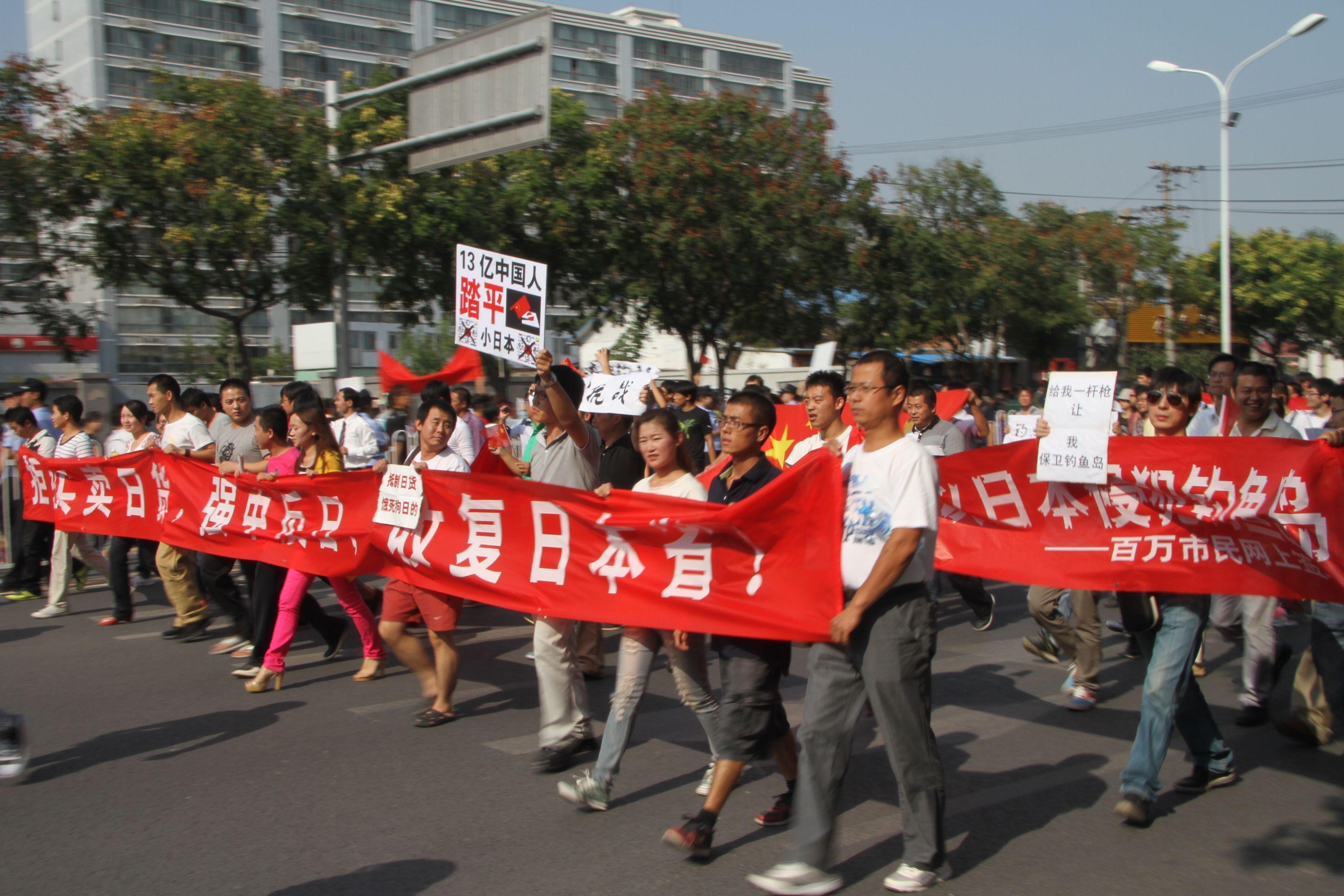
After the purchase, anti-Japanese protests broke out across China, growing from 15 September and continuing on 18 September, the anniversary of the 1931 Mukden Incident. Political scientists Jeremy Wallace and Jessica Chen Weiss counted 377 anti-Japanese protests in 2012 across 208 of China’s 287 prefectural cities. Demonstrators gathered outside the Japanese Embassy in Beijing for days; on 18 September about 50 protesters surrounded the car of US Ambassador Gary Locke as it entered the US Embassy compound, causing minor damage, and the State Department said Chinese authorities had expressed regret.
Some protests turned violent. Japan’s Chief Cabinet Secretary said on 18 September that since 15 September there had been arson and break-ins at Japanese companies, destruction of shop floors and production lines, and looting, and that Japan had lodged further protests. In Xi’an on 15 September, Li Jianli, driving a Japanese-brand car, was surrounded by marchers and struck on the head with a U-lock by 21-year-old Cai Yang, suffering severe injuries; Cai was sentenced to ten years in 2013, and his lawyer described the act as “impulsive and following the crowd, nothing to do with patriotism.” Foreign Ministry spokesman Hong Lei said on 20 September that the protests reflected the Chinese people’s determination to defend their sovereignty and territorial integrity, and that China, as a country governed by law, “protects the safety of foreign institutions and personnel in China according to law.” Asked on 21 September about destructive behaviour at the protests, he said the grave situation in relations had been caused entirely by Japan’s announced “purchase” of Diaoyu Dao.
Meanwhile, on 18 September two Japanese citizens landed on Uotsuri-jima and left after warnings from Japanese police and the coast guard. On 25 September some 75 Taiwanese fishing boats escorted by coast guard vessels approached the islands and exchanged water-cannon fire with Japanese patrol boats. The same day China’s State Council Information Office published the white paper “Diaoyu Dao, an Inherent Territory of China.”
Aftermath
Prime Minister Yoshihiko Noda reportedly later admitted that he had expected the purchase to cause a certain degree of reaction and friction, but that the scale exceeded his expectations. Japan said losses suffered by Japanese companies should in principle be resolved through Chinese legal channels, while it would seek compensation at government level for damage to its embassy and consulates. Many events marking the 40th anniversary of normalised relations were affected. The United States said it took no position on the ultimate sovereignty of the islands but recognised Japan’s effective administrative control and therefore the applicability of Article 5 of the US–Japan Security Treaty. China’s white paper said its marine surveillance vessels conduct law-enforcement patrols in the waters and its fishery vessels carry out regular patrols and fishery protection.
Gallery
Narrative Comparison
| Source | Narrative |
|---|---|
| Foreign Ministry statement (10 September 2012); spokesman Hong Lei (20–21 September 2012); white paper on Diaoyu Dao (September 2012) | The Chinese government held that Diaoyu Dao has been sacred Chinese territory since ancient times, was stolen by Japan in 1895 and returned to China after the war under the Cairo Declaration and Potsdam Proclamation; that the purchase was a grave violation of China’s sovereignty, “entirely illegal and invalid,” and the product of Tokyo indulging right-wing forces; and that it betrayed the understanding of the two countries’ older leaders to “leave the Diaoyu Dao issue aside for later resolution.” China responded by announcing baselines and sending government vessels on regular patrols. Of the protests, the Foreign Ministry said they reflected the people’s determination to defend sovereignty, that China “protects the safety of foreign institutions and personnel in China according to law,” and that the grave situation had been caused entirely by Japan’s announced “purchase” of Diaoyu Dao, while Japan’s denial of any dispute ignored history and law. |
| Press conferences of Chief Cabinet Secretary Osamu Fujimura (10, 11, 14, 18 and 20 September 2012) | The Japanese government held that the Senkaku Islands are “clearly an inherent territory of Japan” in light of history and international law, under Japan’s valid control. “There exists no issue of territorial sovereignty to be resolved.” Having leased the three islands since 2002, it decided to buy them when the owner indicated a wish to sell, in order to maintain and manage them peacefully and stably and continue navigation-safety operations; this was merely a transfer of land ownership within Japanese territory from a private owner to the government, “not something that should raise any kinds of issues for other countries or regions,” and the government did not use the term “nationalization.” Japan treated the Chinese patrols as entries into its territorial waters, protested the arson, break-ins, destruction and looting of Japanese businesses during the protests, and said corporate losses should mainly be settled through Chinese law while compensation for damage to its diplomatic missions would be sought at government level. |
| CNA on Foreign Minister Timothy Yang (11 September 2012); Ma Ying-jeou’s East China Sea Peace Initiative (5 August 2012, via Taipei Times); CNA on the fishing-boat protest (25 September 2012) | The authorities in Taiwan held that the Tiaoyutais “are the inherent territory of the Republic of China,” under the jurisdiction of Yilan County. Japan’s purchase seriously infringed Taiwan’s territorial sovereignty, hurt Taiwan–Japan relations and heightened regional tension; Taiwan would “absolutely not accept and absolutely not recognize” it, called on Japan to withdraw the decision and said Japan should first admit that a territorial dispute exists. Ma Ying-jeou’s East China Sea Peace Initiative urged all parties to exercise restraint, shelve differences, observe international law and resolve the dispute peacefully, and to agree a code of conduct and a mechanism for joint resource development. Taiwan also stressed that the waters are traditional fishing grounds for its fishermen; on 25 September its coast guard escorted fishing boats to the area to assert fishing rights. |
| Assistant Secretary Kurt Campbell’s Senate testimony (20 September 2012); spokesperson Victoria Nuland (19 September 2012); CRS report R42761 (25 September 2012) | The US government said it does “not take a position on the ultimate sovereignty of these islands” and wants Japan and China to resolve the issue peacefully through dialogue, while acknowledging that Japan maintains effective administrative control and that the islands therefore “fall clearly under article 5 of the Security Treaty.” Washington voiced concern about the demonstrations and said a serious fraying of Japan–China relations “is not in our strategic interest.” The Congressional Research Service noted that since 1972 the United States has held that the Security Treaty covers the islands, recorded Tokyo’s explanation that the purchase was meant to keep the islands from nationalists, and described large-scale protests across China, “some of which resulted in violence.” |
| Jeremy L. Wallace and Jessica Chen Weiss, The China Quarterly 222 (2015), abstract | Wallace and Weiss analysed 377 anti-Japanese protests in 208 of China’s 287 prefectural cities in 2012 and argued that explaining nationalist protest requires attention both to citizens’ propensity to mobilise and to local governments’ fears of instability. They found that state-led patriotism and collective-action resources were positively associated with protest, especially among students and migrants, but that the government’s role “was not monolithically facilitative”: protests were less likely in cities with many unemployed graduates and ethnic minorities, and more likely where leaders were well established. |
Key Milestones
- Ishihara announces purchase plan
Tokyo governor Shintaro Ishihara announces in Washington a plan to buy three of the islands.
- Ma proposes East China Sea Peace Initiative
Taiwan’s Ma Ying-jeou urges all parties to shelve differences, settle peacefully and share resources.
- Japan decides to buy; China announces baselines
A Japanese ministerial meeting confirms the purchase; China protests and announces territorial-sea baselines.
- Cabinet approves purchase funds
Japan’s cabinet approves 2.05 billion yen; Taiwan recalls its envoy to Japan.
- Haijian vessels enter the waters
Six Chinese marine surveillance vessels patrol the waters; Japan says they entered its territorial waters.
- Protests spread, some turn violent
Protests in many cities include vandalism and arson; in Xi’an a car owner, Li Jianli, is gravely injured.
- Protests peak on 18 September
Protests continue; the US ambassador’s car is surrounded in Beijing; two Japanese citizens land on Uotsuri-jima.
- China pledges lawful protection
The Foreign Ministry says China protects foreign institutions and personnel according to law.
- White paper; Taiwanese fishing boats
China publishes its Diaoyu Dao white paper; Taiwanese fishing boats approach the islands and exchange water cannon fire with Japanese vessels.
Last verified:
Cite this page
Chronicles of Modern China. (2026, November 11). Japan’s Purchase of the Diaoyu/Senkaku Islands and the 2012 Anti-Japanese Protests. Retrieved November 11, 2026, from https://www.cmcarchive.org/events/diaoyu-islands-purchase-protests-2012
“Japan’s Purchase of the Diaoyu/Senkaku Islands and the 2012 Anti-Japanese Protests.” Chronicles of Modern China. Last modified November 11, 2026. Accessed November 11, 2026. https://www.cmcarchive.org/events/diaoyu-islands-purchase-protests-2012.
Chronicles of Modern China. Japan’s Purchase of the Diaoyu/Senkaku Islands and the 2012 Anti-Japanese Protests[EB/OL]. (2026-11-11)[2026-11-11]. https://www.cmcarchive.org/events/diaoyu-islands-purchase-protests-2012.