Cross-Strait "Three Links" Launched
On 15 December 2008 direct air transport, direct shipping and direct postal services across the Taiwan Strait began on the same day, realising the air and postal links called for in the 1979 Message to Compatriots in Taiwan; until then travel and goods had to pass through third places. After Ma Ying-jeou took office, ARATS and SEF resumed talks: Chen Yunlin and Chiang Pin-kung signed charter-flight minutes in June, weekend charters began in July, and sea, air and postal agreements were signed in Taipei on 4 November. Beijing said comprehensive direct "three links" had taken a historic step; Ma said "dialogue will replace opposition"; the DPP accused the government of "illegally forcing" the launch before legislative review and of exposing Taiwan to becoming another Hong Kong or Macau. A supplementary air agreement in April 2009 opened scheduled flights.
Background: From the Call for Direct Links to Decades of Indirect Contact
On 1 January 1979 the Standing Committee of the National People's Congress issued its Message to Compatriots in Taiwan, saying "we hope that the two sides will soon establish air and postal services so that compatriots on both sides can have direct contact", and urging the two sides to "develop trade, supply each other's needs and conduct economic exchanges"; postal links, transport links and trade came to be known together as the "three links". For nearly three decades afterwards travel and goods between the two sides had to pass through third places; according to AFP, flights usually had to route through Hong Kong or Macau airspace and cargo ships were generally forced to detour through Japanese waters. Before 2008 holiday charters, emergency medical charters, humanitarian charters and special cargo charters were opened, but only as ad hoc arrangements.
The negotiating channel between the mainland's Association for Relations Across the Taiwan Straits (ARATS) and Taiwan's Straits Exchange Foundation (SEF), set up after the Koo–Wang talks of 1993, broke down after 1999 and did not resume during Chen Shui-bian's eight years in office; AFP reported that Chen had refused Beijing's overtures for direct daily transport links, wary that they would draw the island too close to China.
The Two Chen–Chiang Talks of 2008
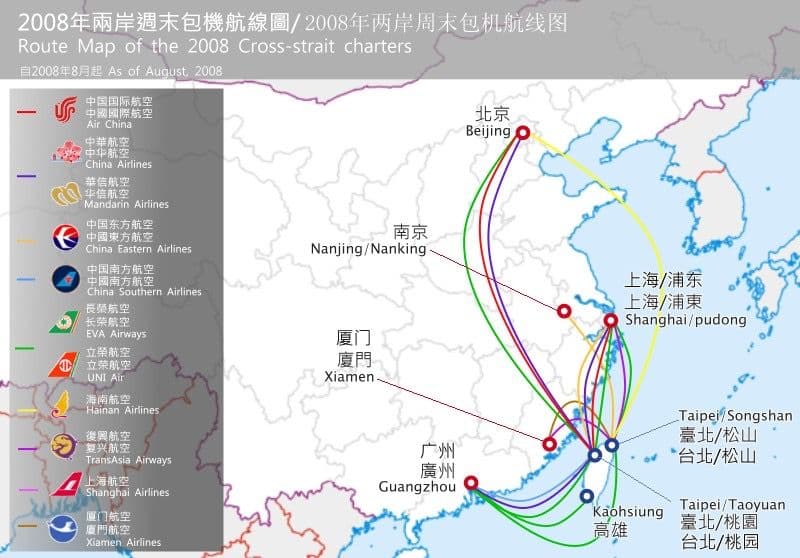
After Ma Ying-jeou took office in May 2008, ARATS president Chen Yunlin and SEF chairman Chiang Pin-kung met in Beijing in June and on 13 June signed the Minutes of Talks on Cross-Strait Charter Flights, opening weekend passenger charters "formally from 4 July"; until direct routes opened, the charters would temporarily route through the Hong Kong flight information region.
On 4 November 2008 Chen and Chiang signed in Taipei agreements on sea transport, air transport and postal services, together with an agreement on food safety, each to "take effect within forty days of signing". The air agreement opened a northern direct two-way route across the Taiwan Strait and turned the weekend flights into "regularised passenger charters", with 21 points opened on the mainland, including Beijing and Shanghai, and eight in Taiwan, including Taoyuan, Taipei Songshan and Kaohsiung, for up to 108 round trips a week; the sea agreement allowed ships owned by capital from either side and registered on either side to carry passengers and cargo directly, required them while in the other side's ports to "fly the company flag, with no flag for the time being at the stern or mainmast", and exempted shipping income from business and income taxes on both sides; the postal agreement opened direct letter, parcel, express mail and postal remittance services.
15 December: Direct Transport and Post Launched Together
On 15 December 2008 direct air transport, direct shipping and direct postal services between the two sides began on the same day. According to CNA, a flight from Shenzhen landed in Taipei shortly before 9 a.m. and the first flight from Taipei to Shanghai departed at 8 a.m.; ships could now sail between 11 ports in Taiwan and 63 on the mainland without transiting a third region, and send-off ceremonies were held at Keelung, Taichung and Kaohsiung. According to AFP, the new route cut the Shanghai–Taipei flight by more than an hour to about 80 minutes, and Taiwanese officials estimated that airlines and passengers would save about NT$3 billion a year and shipping firms more than NT$4 billion.
Wang Yi, director of the Taiwan Affairs Office, told a shipping ceremony in Tianjin that it was "another important day in the history of cross-strait relations" and that "the trend of peaceful development for the relationship between two sides cannot be stopped" (as quoted by AFP). At a ribbon-cutting in Kaohsiung, Ma Ying-jeou said: "From now on, dialogue will replace opposition."
Reactions
On 17 December the DPP Central Standing Committee issued a statement saying that "the three links are a major national policy bearing on national sovereignty and security", accusing the Ma government of "illegally forcing the launch of the three links before the Legislative Yuan had reviewed the four agreements", and charging that it had "pinned its hopes for economic development on China, exposing Taiwan to the danger of becoming another Hong Kong or Macau", without measures for the relocation of traditional industries, competition for farm products or unemployment.
On 31 December Hu Jintao told a meeting marking the 30th anniversary of the Message to Compatriots in Taiwan that since May cross-Strait talks had "resumed on the basis of the '1992 Consensus' and achieved important results, and comprehensive, direct and two-way 'three links' have taken a historic step", and among six proposals for the peaceful development of cross-Strait relations called for "expanding the direct 'three links'" and for a comprehensive economic cooperation agreement.
Aftermath
What began on 15 December were regularised charter flights rather than scheduled services. On 26 April 2009 Chen Yunlin and Chiang Pin-kung signed in Nanjing a Supplementary Agreement on Cross-Strait Air Transport providing for scheduled passenger and cargo flights and opening a southern route and a second northern route. By the time Ma Ying-jeou met Xi Jinping in Singapore in November 2015, the heads of the two associations had held eleven rounds of talks.
Narrative Comparison
| Source | Narrative |
|---|---|
| Hu Jintao's speech on the 30th anniversary of the Message to Compatriots in Taiwan (31 December 2008); Wang Yi in Tianjin (15 December 2008, as quoted by AFP) | Beijing placed the three links in the line of its Taiwan policy since the 1979 Message to Compatriots in Taiwan. Hu Jintao said that in March 2008 "the situation in Taiwan underwent positive changes and cross-Strait relations met a rare historic opportunity", that since May talks had "resumed on the basis of the '1992 Consensus'", and that "comprehensive, direct and two-way 'three links' have taken a historic step"; he called for "expanding the direct 'three links' and deepening common interests" and for a comprehensive economic cooperation agreement. On launch day Wang Yi said "the trend of peaceful development ... cannot be stopped". |
| Ma Ying-jeou in Kaohsiung (15 December 2008, as quoted by AFP) | The Ma government presented the direct links as a sign that cross-Strait relations were shifting from confrontation to cooperation. At the ribbon-cutting for a direct shipping service in Kaohsiung Ma said: "From now on, dialogue will replace opposition", and "the two sides can work together for peace and prosperity". Taiwanese officials estimated annual savings of about NT$3 billion for airlines and passengers and more than NT$4 billion for shipping firms. |
| Statement of the DPP Central Standing Committee (17 December 2008) | The DPP said the three links bore "on national sovereignty and security" and accused the Ma government of "illegally forcing the launch of the three links before the Legislative Yuan had reviewed the four agreements, treating parliamentary oversight and public opinion as nothing". It warned that the government had "pinned its hopes for economic development on China, exposing Taiwan to the danger of becoming another Hong Kong or Macau", and that economic dependence would leave Taiwan "politically constrained by China"; it also faulted the government for caring only about the "winners" while offering no measures for the "losers" — traditional industries, farmers and the unemployed. |
| Jean-Pierre Cabestan (Hong Kong Baptist University), China Perspectives 2010/3; Gordon C. K. Cheung, Journal of Current Chinese Affairs (2010) | Cheung argues that the legislative and presidential elections of January and March 2008 "re-orientated cross-Strait relations from hostility to co-operation" and that the agreements on air and sea transport, postal services and food safety signed at the second Chen–Chiang talks on 4 November were "a historical step", making continued integration seem inevitable though in need of more institutionalisation. Cabestan notes that the détente looked at first glance like a welcome development for Taiwan, China and the United States, but was "an armed détente in which security issues have yet to be addressed": accelerating economic integration was increasing Beijing's influence over Taiwan while the threat from the People's Liberation Army continued to intensify. |
| Shanghai Airlines chairman Zhou Chi at the send-off of his carrier's first daily direct flight (15 December 2008, as reported by AFP) | Seeing off his airline's first daily direct flight in Shanghai, Shanghai Airlines chairman Zhou Chi told reporters: "I think this is a market with huge growth potential given there are millions of Taiwanese here." With the direct route, the Shanghai–Taipei flight was cut by more than an hour to 80 minutes. |
Key Milestones
- Message to Compatriots in Taiwan
The NPC Standing Committee calls for air and postal services and trade across the Strait.
- Charter-flight minutes signed
Chen Yunlin and Chiang Pin-kung sign the minutes on weekend charter flights in Beijing.
- Weekend charters begin
Weekend passenger charters begin, routing temporarily through the Hong Kong flight information region.
- Sea, air and postal agreements signed
The second Chen–Chiang talks in Taipei produce agreements on sea transport, air transport, postal services and food safety.
- Direct links launched
Direct air transport, direct shipping and direct postal services begin on the same day.
- Hu Jintao's six proposals
Hu Jintao says comprehensive direct "three links" have taken a historic step and calls for expanding them.
- Supplementary air agreement
The two associations sign a supplementary agreement in Nanjing providing for scheduled flights.
Last verified:
Cite this page
Chronicles of Modern China. (2026, November 1). Cross-Strait "Three Links" Launched. Retrieved November 1, 2026, from https://www.cmcarchive.org/events/cross-strait-three-links-2008
“Cross-Strait "Three Links" Launched.” Chronicles of Modern China. Last modified November 1, 2026. Accessed November 1, 2026. https://www.cmcarchive.org/events/cross-strait-three-links-2008.
Chronicles of Modern China. Cross-Strait "Three Links" Launched[EB/OL]. (2026-11-01)[2026-11-01]. https://www.cmcarchive.org/events/cross-strait-three-links-2008.