Adoption of the 1982 Constitution
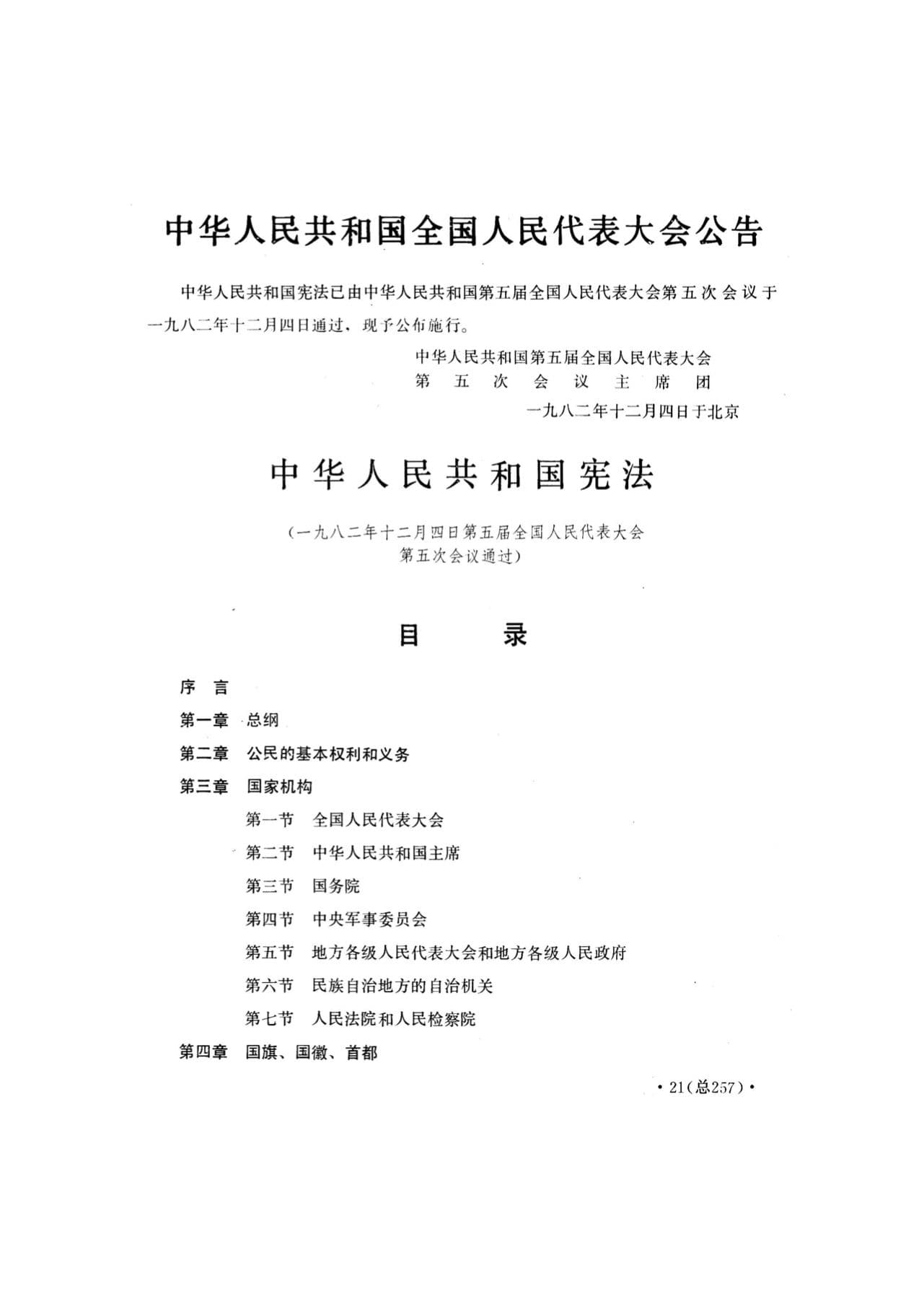
On 4 December 1982 the Fifth Session of the Fifth NPC adopted the current Constitution of the PRC by 3,037 votes to none, with 3 abstentions. Prepared by a revision committee set up in 1980 and based on the 1954 Constitution, the draft went through four months of nationwide discussion. It took the Four Cardinal Principles as its guiding ideology, placed citizens' rights before state organs, restored the State Presidency and limited top state leaders to two consecutive terms. It has since been amended several times, with the presidential term limit removed in 2018.
Background
The 1975 and 1978 Constitutions had been drafted under a guiding ideology that affirmed the Cultural Revolution. After the Third Plenum of December 1978, the NPC twice amended the 1978 Constitution in part, in 1979 and 1980. On 18 August 1980 Deng Xiaoping delivered his speech "On the Reform of the System of Party and State Leadership" to an enlarged Politburo meeting, criticising over-concentration of power, patriarchal practices and the de facto life tenure of leading cadres, and put a full revision of the Constitution on the agenda. On 30 August the CPC Central Committee proposed to the Third Session of the Fifth NPC that the Constitution be revised and a revision committee formed; on 10 September the session set up a 103-member Constitution Revision Committee, with Ye Jianying as chairman and Song Qingling and Peng Zhen as vice-chairmen. Its secretariat was headed by Hu Qiaomu and included constitutional scholars such as Xu Chongde, Wang Shuwen and Xiao Weiyun; from mid-July 1981 Peng Zhen took over from Hu.
Drafting and Nationwide Discussion
According to Xu Chongde, Peng Zhen considered the 1978 Constitution "too simple" and proposed using the 1954 Constitution as the basis, which the centre approved; Deng said "the new constitution should give people a sense of a fresh look". During the revision the Central Secretariat discussed drafts eight times and the Politburo three times. Peng Zhen later said that the 1981 Resolution on Certain Questions in the History of Our Party and the documents of the 12th Party Congress "provided an important basis for the revision". There were disagreements. According to Cheng Zhongyuan, when the Secretariat met on 16 February 1982 some proposed placing the chapter on state organs before the chapter on citizens' rights and duties; Hu Qiaomu objected and had Wang Shuwen and others survey foreign constitutions, finding that 101 of 111 placed rights first; the next day Deng sided with Hu. Whether to restore the office of State President was "deliberated for more than a year".
The committee produced a discussion draft in February 1982; on 26 April the NPC Standing Committee published the draft for nationwide discussion, which ran for four months until the end of August. Peng Zhen said the draft was supplemented and revised in "nearly a hundred places" as a result. The committee adopted the draft at its fifth meeting on 23 November, and on 26 November Peng reported to the Fifth Session of the Fifth NPC that "the overall guiding ideology" of the revision was the Four Cardinal Principles.
Adoption
On 4 December 1982 the Fifth Session of the Fifth NPC adopted the new Constitution by secret ballot, and it was promulgated the same day. According to Caijing (2012), executive chairman Xi Zhongxun announced 3,037 votes in favour, none against and 3 abstentions — the first time an NPC session had published the vote on a law. The Constitution comprises a Preamble and four chapters (General Principles; Fundamental Rights and Duties of Citizens; State Organs; National Flag, Emblem and Capital) with 138 articles. Known as the "1982 Constitution", it remains in force.
Main Provisions
The Preamble writes the Four Cardinal Principles into a narrative of twentieth-century Chinese history. Article 1 restores the 1954 term "people's democratic dictatorship". The chapter on citizens' rights and duties was moved ahead of the chapter on state organs; the principle that "all citizens are equal before the law" was restored, and Article 35 grants freedom of speech, press, assembly, association, procession and demonstration. Article 5 provides that "all acts in violation of the Constitution and the law must be investigated" and that "no organisation or individual may enjoy the privilege of being above the Constitution and the law".
On state organs, the Constitution restored the offices of President and Vice-President, created a state Central Military Commission, expanded the powers of the NPC Standing Committee, and provided that the President, Vice-President, NPC Standing Committee chairman and vice-chairmen, Premier and Vice-Premiers "shall serve no more than two consecutive terms" — which, Peng Zhen said, "abolishes the de facto life tenure of leading posts". It ended the merger of government and economic management in the people's communes by establishing township governments; Article 31 allows the state to "establish special administrative regions when necessary"; Article 18 permits foreign enterprises and individuals to invest in China; and Article 126 provides that the courts exercise judicial power independently according to law.
Amendments and Later Debate
The 1982 Constitution has since been amended several times: the 1988 amendment allowed the private economy to "exist and develop within the limits prescribed by law" and permitted the transfer of land-use rights; the 1993 amendment added that China "is in the primary stage of socialism" and that "the state practises a socialist market economy"; the 1999 amendment added Deng Xiaoping Theory and "governing the country according to law and building a socialist country under the rule of law"; the 2004 amendment added that "citizens' lawful private property is inviolable" and that "the state respects and preserves human rights"; and the 2018 amendment removed the two-term limit on the President and Vice-President.
On 4 December 2012 Xi Jinping told a meeting marking the 30th anniversary that "the life of the Constitution lies in its implementation, and so does its authority", while acknowledging that "the supervisory mechanisms and specific systems for ensuring implementation of the Constitution are still not sound". On 1 November 2014 the NPC Standing Committee designated 4 December as National Constitution Day. Charter 08, issued in December 2008, argued that progress such as the human-rights clause had "remained on paper": "there are laws but no rule of law, there is a constitution but no constitutional government". It called for a constitutional court and a system of constitutional review.
Narrative Comparison
| Source | Narrative |
|---|---|
| Peng Zhen's report (26 Nov. 1982); Xi Jinping's 30th-anniversary speech (4 Dec. 2012) | Official accounts treat the 1982 Constitution as the product of setting things right after the Cultural Revolution and summing up historical experience, while stressing Party leadership. Peng Zhen said in 1982 that the draft "scientifically summed up the historical experience of China's socialist development", took the Four Cardinal Principles as its guiding ideology, and quoted Hu Yaobang's 12th Congress report that "the Party must act within the scope of the Constitution and the laws". Xi Jinping said in 2012 that the Constitution is "the general charter for governing the country", that "its life lies in its implementation" and that "governing according to law means first of all governing according to the Constitution", while stressing that "the Party leads the people in making and implementing the Constitution and laws". |
| Weng, The China Quarterly 91, 1982 (abstract); Thornton, The China Quarterly 248(S1), 2021 (abstract) | Western scholars at the time saw the 1982 draft as a clear return to the 1954 model. Byron Weng (1982) called it "the most comprehensive, detailed (if somewhat wordy) and reasonable (as opposed to revolutionary, erratic)" draft since 1949, produced with the participation of scholars and legal professionals as well as politicians and cadres, and expected the state constitution to "set the tone for the Party Constitution ... rather than the other way round". Later work focuses more on the relationship between the Constitution and Party power: Oxford's Patricia Thornton (2021) argues that democratic centralism is critical to understanding "Party-driven constitutionalism" and describes leadership under Xi as "normatively unconstrained extra-constitutional leadership". |
| Xu Chongde, The Jurist, 2002 no. 6; Guo Daohui as quoted in Caijing, 2012 no. 26 | Participants' recollections stress the impact of the Cultural Revolution. Xu Chongde (2002), a member of the revision committee's secretariat, recalled that a proposal in 1954 to put citizens' rights before state organs had been rejected, but "after 28 years, and after the 'ten years of catastrophe' that trampled human rights", it "was at last accepted"; he also stressed that the process combined "Party leadership with the mass line". Guo Daohui, then on the staff of the NPC Standing Committee's Legislative Affairs Commission, recalled that most committee members "had suffered in the Cultural Revolution as so-called capitalist-roaders", and that Peng Zhen said, "I spent six years in a Kuomintang prison and nine and a half years locked up in the Cultural Revolution", calling it "the punishment we received for not valuing democracy and the legal system". |
Key Milestones
- Deng's speech on leadership reform
At an enlarged Politburo meeting Deng criticises life tenure and other practices, putting full constitutional revision on the agenda.
- Constitution Revision Committee formed
The Third Session of the Fifth NPC sets up a 103-member revision committee chaired by Ye Jianying.
- Deng backs placing rights first
According to Cheng Zhongyuan, Deng agrees with Hu Qiaomu to place citizens' rights and duties before state organs.
- Draft published for discussion
The NPC Standing Committee publishes the draft; nationwide discussion lasts four months, to the end of August.
- Peng Zhen's report
Peng Zhen reports to the Fifth Session of the Fifth NPC that the guiding ideology is the Four Cardinal Principles.
- 1982 Constitution adopted
Adopted with 3,037 in favour, none against and 3 abstentions, and promulgated the same day.
- First amendment
Permits the private economy within legal limits and the transfer of land-use rights.
- Human rights clause added
The amendment adds "the state respects and preserves human rights" and protection of lawful private property.
- National Constitution Day established
The NPC Standing Committee designates 4 December as National Constitution Day.
- Presidential term limit removed
An amendment removes the two-consecutive-term limit on the President and Vice-President.
Last verified:
Cite this page
Chronicles of Modern China. (2026, October 24). Adoption of the 1982 Constitution. Retrieved October 24, 2026, from https://www.cmcarchive.org/events/constitution-1982
“Adoption of the 1982 Constitution.” Chronicles of Modern China. Last modified October 24, 2026. Accessed October 24, 2026. https://www.cmcarchive.org/events/constitution-1982.
Chronicles of Modern China. Adoption of the 1982 Constitution[EB/OL]. (2026-10-24)[2026-10-24]. https://www.cmcarchive.org/events/constitution-1982.