Chinese Expeditionary Force in the First Burma Campaign (1942)
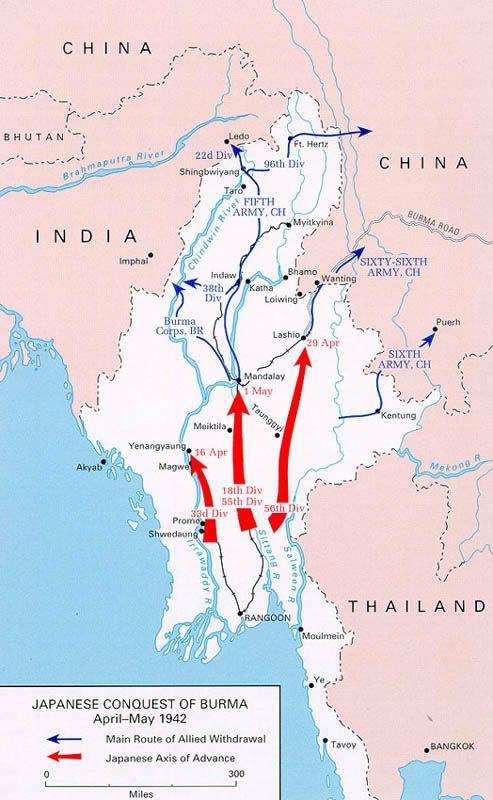
After the Pacific War began, Japan invaded Burma in January 1942, threatening the Burma Road, China’s last overland supply route. At Britain’s request the Nationalist government sent more than 100,000 men of the 5th, 6th and 66th Armies into Burma as the Chinese Expeditionary Force under the American general Joseph Stilwell. The 200th Division held Toungoo for twelve days and the New 38th Division’s 113th Regiment freed more than 7,000 encircled British troops at Yenangyaung, but the Allied defence as a whole failed. The fall of Lashio on 29 April cut the force’s route home; some units returned to Yunnan while others retreated to India through the mountains of northern Burma, where many died of hunger and disease, and the 200th Division’s commander Dai Anlan died of his wounds. The U.S. Army history records Japanese claims of 1,280 dead and gives no total for Chinese losses. Mainland official accounts stress the first Chinese campaign abroad alongside the Allies, accounts in Taiwan highlight Yenangyaung, and Stilwell said the Allies “got a hell of a beating”.
The Burma Road and the Decision to Intervene
After the Pacific War broke out in December 1941, Japanese forces invaded Burma from Thailand in January 1942. Burma carried the Burma Road, China’s last overland route for foreign aid. According to an article in The Paper, at the end of 1941 China and Britain signed an agreement in Chongqing on the joint defence of the Burma Road, and the Nationalist government formed the Chinese Expeditionary Force from its 5th, 6th and 66th Armies; because of British obstruction, as late as February 1942 only part of the 6th Army had entered Burma while the rest waited along the road. On 26 February Deputy Prime Minister Clement Attlee told the House of Commons that the Chinese offer of troops “has been gratefully accepted” and that Chinese troops had already moved into Burma, denying reports that Britain had refused it.
According to a 2025 People’s Daily article, more than 100,000 men in ten divisions of the 5th, 6th and 66th Armies entered Burma under Du Yuming, deputy commander of the First Route Army. The 5th Army entered Burma as the vanguard on 16 February, and the 200th Division reached Toungoo on 7 March. General Joseph Stilwell, sent by the United States to the China theatre, was entrusted by Chiang Kai-shek with command of the Chinese forces in Burma. The U.S. Army’s official history notes that the divisions varied greatly in size — the 200th began with about 8,500 men and was fully motorized, while the 5th Army’s other two divisions had about 6,000 each — that medical supplies were almost nil and “the Chinese medical organization was largely on paper”, and that the Government of Burma allowed only one Chinese division at a time in Mandalay, hampering concentration.
The Defence of Toungoo
Dai Anlan’s 200th Division took over from British forces and fortified Toungoo. The U.S. Army history records that the Japanese 55th Division began attacking the 200th’s outposts on 19 March and on the 24th outflanked it, seizing the airfield and cutting the road and railway to the north, so that Toungoo was besieged; the Chinese held stubbornly, and “for three days the struggle rocked back and forth within the walls.” Zheng Zhong, a liaison officer with the division, recalled that on 22 March, at the height of the fighting, Dai made his will, naming his successors should he be killed.
Stilwell planned to relieve the town with the 22nd Division, but it did not move. Stilwell, the official history says, now began to learn that despite Chiang’s assurances in Chongqing “he did not command”, and “Tu was prolific with excuses as to why an attack was impossible.” The 200th Division withdrew from Toungoo on 30 March (Zheng recalls the 29th); “The withdrawal was well handled, and the 200th Division got away intact.” The history calls it “the longest defensive stand made by any of Burma’s defenders” and notes that the Japanese later looked back on it as “the hardest fighting of the campaign”. A 2025 Xinhua report says the twelve-day defence cost the 200th Division 800 dead and annihilated more than 4,000 Japanese. Zheng recalled Dai weeping on receiving the withdrawal order: “We fought bravely, we won, and now we just retreat? What kind of soldiers are we? I have no face to go home! I will die here!”
The Relief at Yenangyaung
In mid-April the 1st Burma Division was retreating along the Irrawaddy. The U.S. Army history records that from 1 a.m. on 15 April the great Yenangyaung oil fields were burned on General William Slim’s order; part of the Japanese 33rd Division then got round to the Pin Chaung ford north of Yenangyaung and blocked the British retreat. The New 38th Division, sent toward the Irrawaddy on Chiang Kai-shek’s orders, came to the aid of the British, its commander Sun Li-jen taking personal command of the 113th Regiment’s operations.
According to the People’s Daily article, the 113th Regiment attacked at dawn on the 18th, recovered the oilfield area by 2 p.m. on the 19th and freed more than 7,000 encircled British troops and more than 500 captured British and American missionaries and journalists. The Taiwanese scholar Ho Shih-tung, citing the Taiwan defence ministry’s official war history, writes that the 113th Regiment with 1,121 men routed a regiment of the Japanese 33rd Division (Ho gives it as the 124th; the U.S. Army history identifies the force blocking the Pin Chaung ford as the 214th), killing more than 700, at a cost of 318 wounded and 189 killed including battalion commander Zhang Qi; he also cites the regimental commander Liu Fangwu’s recollection that, because inflated strength returns were common, only some 800 men actually fought. Ho argues that without the Chinese rescue the British would have been wiped out, and notes that deliberate concealment by some Chinese and foreign figures and the 1955 Sun Li-jen case have left accounts of the battle divided. The U.S. Army history calls Yenangyaung Sun’s “tactical feat”.
The Collapse
In late April Japanese forces drove up through the Shan States and on 29 April took Lashio on the Burma Road, cutting the expeditionary force’s main route home. The U.S. Army history records that “The evacuation of the 5th Army was without Stilwell’s orders and was the beginning of the collapse”. Zheng Zhong recalled that after the 200th Division attacked Taunggyi on 25 April, Du Yuming arrived that night and ordered it not to linger but to return home along the Burma-Thailand border because Lashio had fallen and the border was impassable.
On 5 May Stilwell, judging that he could not reach Myitkyina before the Japanese, decided to lead his party west to India on foot; the Japanese took Myitkyina on 8 May. Under an understanding of 30 April the Chinese should have marched out to India, but “orders from the Generalissimo sent the 96th and 22d Divisions wandering through northern Burma.” Sun Li-jen took the New 38th Division to India through the Chin Hills, its main body arriving on 25 May; the official history credits him with bringing it out “as an intact fighting unit with discipline and morale unimpaired.”
After twenty days’ march through the jungle, the 200th Division was ambushed on the night of 18 May near the Hsipaw–Mogok road, and Dai Anlan was hit by two bullets. Zheng recalled that Dai’s wounds were dressed only with plant ash and never stopped bleeding; he died on the afternoon of 26 May at Maobang village in northern Burma, aged 38. Xinhua reports that Mao Zedong wrote an elegy for his memorial ceremony.
The Wild Men’s Mountains
The 5th Army headquarters, the 22nd Division and other units retreated toward India through the Hukawng Valley and the mountains of northern Burma. The U.S. Army history records that survivors of the 22nd Division emerged in the Ledo area in July and August over the “refugee trail”; the local British area commandant estimated that “about 30,000 persons essayed the refugee trail, of whom 23,000 succeeded”, soldiers and civilians together, and American and British aircraft dropped food along the way. It also records the report of Colonel Boatner that soldiers of the 96th Division “looted and murdered among the refugees and Kachin tribesmen” and that many officers showed “incompetence and callousness in handling the food dropped to them”, in contrast with the discipline of the 38th Division. The Paper says that tens of thousands of soldiers perished in the mountains and only some 30,000 made it through.
Outcome and Assessments
By the end of May 1942 Japan held most of Burma, and China’s overland link with the outside world was completely severed. The U.S. Army history counts the defeated Allied force at 9 Chinese divisions and British, Indian and Burmese units, “totaling perhaps 81,000 men”, against 10 Japanese infantry and 2 armoured regiments, and notes that the Japanese “claimed to have lost 1,280 dead and 3,158 wounded”; it gives no total for Chinese losses. Arriving in India on 15 May, Stilwell said bluntly: “We got a hell of a beating. It was as humiliating as hell. We ought to find out why it happened and go back!” In his diary he blamed a hostile population, the lack of air support, inferior equipment, chaotic supply and transport, incompetent command and interference by Chiang Kai-shek.
On 3 June Foreign Secretary Anthony Eden told the Commons that “The Chinese troops contributed very materially indeed towards protracting the delaying action fought by Imperial Forces in Burma” and that good co-operation had prevailed wherever the two armies fought side by side. Mainland Chinese official accounts stress that although the force could not reverse the defeat in Burma, it was the first time Chinese troops fought abroad alongside the Allies, an important contribution to the world anti-fascist war. In Taiwan the relief of Yenangyaung is especially emphasised; at a 2015 commemoration of Sun Li-jen, Ma Ying-jeou said the victory there and the later counteroffensive in north Burma had won China the respect of Britain and the United States. The New 38th and 22nd Divisions that reached India later formed the Chinese Army in India, which from 1943 joined the forces in western Yunnan in the counteroffensive in north Burma.
Gallery
Narrative Comparison
| Source | Narrative |
|---|---|
| People’s Daily (2025); Xinhua (2025) | Mainland Chinese official accounts frame the operation as a mission to aid Britain at its request: more than 100,000 men in ten divisions entered Burma; at Toungoo the 200th Division lost 800 men while annihilating more than 4,000 Japanese; at Yenangyaung the 113th Regiment freed more than 7,000 British troops and over 500 captured missionaries and journalists. They acknowledge that the force “could not reverse the decline of the defence of Burma”, but stress that it was the first time Chinese troops fought abroad alongside the Allies, an important contribution to the world anti-fascist war, and commemorate fallen commanders such as Dai Anlan, for whom Mao Zedong wrote an elegy. |
| Ho Shih-tung, National Defense Journal (2017); Ma Ying-jeou, 2015 (via The Paper) | Accounts in Taiwan centre on Yenangyaung. Writing in Taiwan’s National Defense University journal, Ho Shih-tung argues that although the campaign ended in defeat, the defence of Toungoo and the relief of Yenangyaung were two outstanding performances; with 1,121 men the 113th Regiment routed a Japanese regiment and rescued more than 7,000 British troops — the most glorious page in the expeditionary force’s history — and without the Chinese rescue the British would have been wiped out. He holds that deliberate concealment by some Chinese and foreign figures and the 1955 Sun Li-jen case left the history disputed, and seeks to restore credit to the regimental commander Liu Fangwu. In 2015 Ma Ying-jeou said Sun Li-jen’s victory at Yenangyaung and the counteroffensive in north Burma won China the respect of Britain and the United States. |
| U.S. Army official history, Stilwell’s Mission to China (1953) | The U.S. Army history tells the campaign from Stilwell’s side and dwells on command: nominally in charge of the Chinese armies, Stilwell found at Toungoo that “he did not command”, as the 22nd Division would not move and “Tu was prolific with excuses”; the 5th Army withdrew without his orders, and Chiang’s orders sent two divisions “wandering through northern Burma”. It praises the 200th Division’s defence of Toungoo and Sun Li-jen’s conduct at Yenangyaung and in the retreat, while recording reports of looting by some Chinese units and officers’ “incompetence and callousness” on the march out. Stilwell’s own verdict: “We got a hell of a beating. It was as humiliating as hell.” |
| Hansard: Attlee (26 February 1942) and Eden (3 June 1942) | The British government spoke appreciatively of the Chinese intervention in Parliament. In February 1942, answering reports that Britain had refused Chinese troops, Deputy Prime Minister Attlee said the offer “has been gratefully accepted” and that Chinese troops had already moved into Burma, calling the reports of refusal incorrect. After the withdrawal, Foreign Secretary Eden told the Commons in June that “The Chinese troops contributed very materially indeed towards protracting the delaying action fought by Imperial Forces in Burma”, and that “good feeling and a spirit of co-operation prevailed whenever and wherever the two armies fought side by side.” |
| Recollections of Zheng Zhong, liaison officer of the 200th Division’s 599th Regiment (CPPCC Daily, 2017) | Zheng Zhong entered Burma with the 200th Division and served at Dai Anlan’s side. He recalled that Dai made his will at the height of the Toungoo fighting, and that when army headquarters ordered Toungoo abandoned after the Japanese crossed the river and seized the airfield, Dai cried out: “We fought bravely, we won, and now we just retreat?” After Lashio fell, Du Yuming ordered the division home along the Burma-Thailand border, and it marched twenty days through the jungle without food. On the night of 18 May Dai was wounded in an ambush near the Hsipaw–Mogok road; with only plant ash on his wounds he bled continuously and died on his stretcher at Maobang on the afternoon of 26 May, aged 38. |
Key Milestones
- Sino-British Burma Road defence agreement
China and Britain sign an agreement in Chongqing; the Nationalist government forms the Expeditionary Force.
- 5th Army enters Burma
The 5th Army enters Burma as the vanguard.
- Britain confirms acceptance of Chinese troops
Attlee tells the Commons the Chinese offer has been accepted.
- 200th Division reaches Toungoo
Dai Anlan’s 200th Division takes over the defence of Toungoo.
- Battle of Toungoo begins
The Japanese 55th Division attacks the 200th Division’s outposts.
- 200th Division leaves Toungoo
The 200th Division withdraws intact after its stand.
- Relief at Yenangyaung
The New 38th Division’s 113th Regiment frees the encircled British troops.
- Fall of Lashio
The Japanese take Lashio, cutting the force’s route home.
- Stilwell heads for India on foot
Stilwell leads his party west toward India.
- Japanese take Myitkyina
The northern route home is cut.
- Stilwell reaches India
Stilwell: “We got a hell of a beating.”
- New 38th Division reaches India
Sun Li-jen brings the division through the Chin Hills.
- Death of Dai Anlan
Dai Anlan dies of his wounds at Maobang in northern Burma.
- Eden praises Chinese troops
Eden says Chinese troops contributed materially to the delaying action.
- 22nd Division survivors reach Ledo
Survivors of the 22nd Division emerge at Ledo in July–August.
Last verified:
Cite this page
Chronicles of Modern China. (2026, November 24). Chinese Expeditionary Force in the First Burma Campaign (1942). Retrieved November 24, 2026, from https://www.cmcarchive.org/events/chinese-expeditionary-force-burma-1942
“Chinese Expeditionary Force in the First Burma Campaign (1942).” Chronicles of Modern China. Last modified November 24, 2026. Accessed November 24, 2026. https://www.cmcarchive.org/events/chinese-expeditionary-force-burma-1942.
Chronicles of Modern China. Chinese Expeditionary Force in the First Burma Campaign (1942)[EB/OL]. (2026-11-24)[2026-11-24]. https://www.cmcarchive.org/events/chinese-expeditionary-force-burma-1942.