China Eastern Flight MU5735 Crash (2022)
On 21 March 2022 China Eastern flight MU5735, a Boeing 737-800 flying from Kunming to Guangzhou, suddenly descended from cruising altitude and crashed into wooded hills in Teng county, Wuzhou, Guangxi, killing all 123 passengers and 9 crew. Xi Jinping ordered an all-out rescue and a swift investigation. The CAAC’s preliminary report and anniversary updates in 2023 and 2024 ruled out problems with crew qualifications, airworthiness, weather, air traffic control and dangerous goods but stated no cause, and no final report has been published. In 2026 the United States released, under its Freedom of Information Act, a 2022 recorder data report by the National Transportation Safety Board, which took part in the investigation; it records that the fuel switches of both engines were moved to “cutoff” while the aircraft was cruising at 29,000 ft.
The Crash
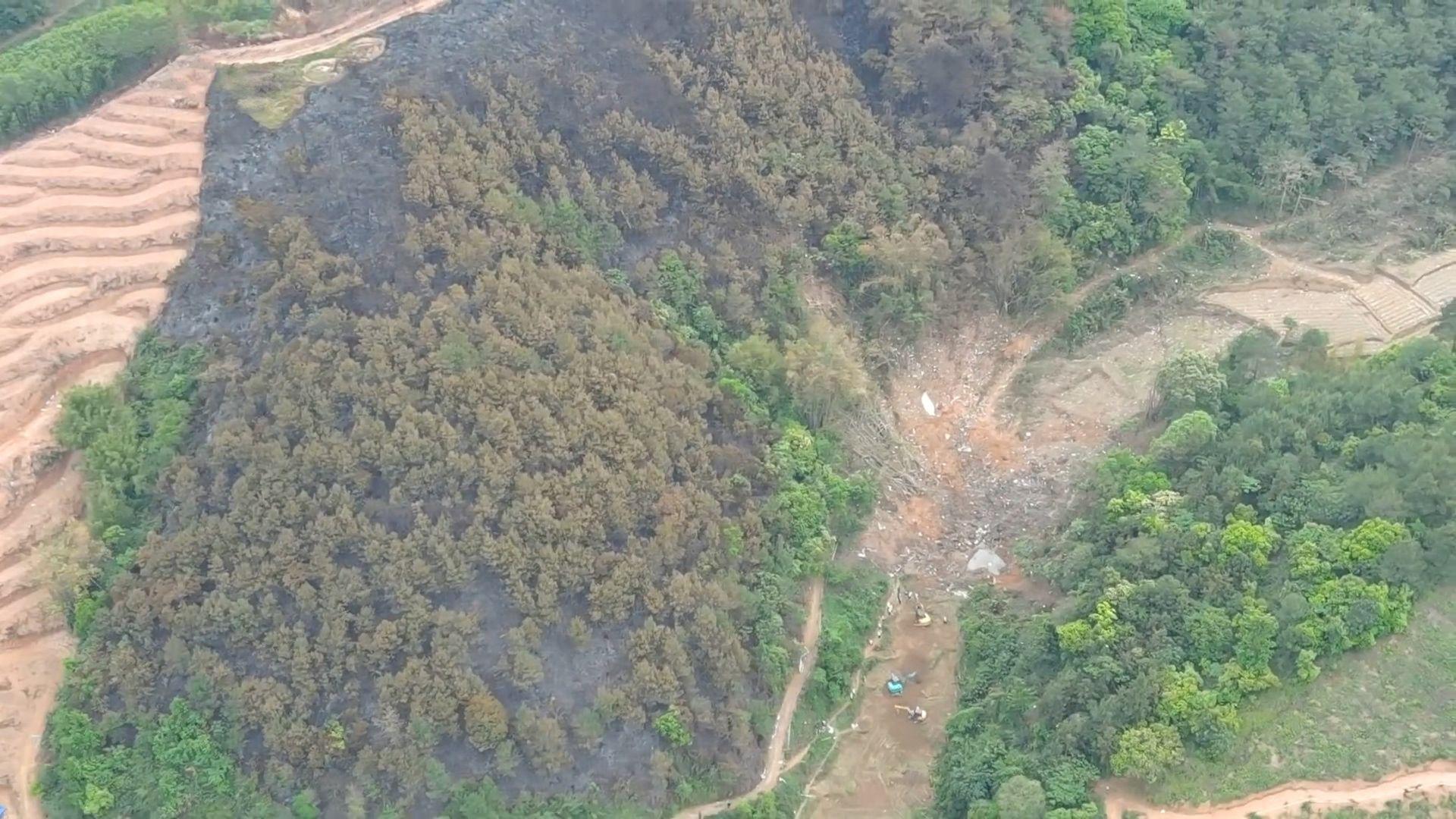
On 21 March 2022 a China Eastern Yunnan Boeing 737-800 (registration B-1791) operating flight MU5735 from Kunming to Guangzhou took off from Kunming Changshui at 13:16 and reached its cruising altitude of 8,900 m at 13:27. At 14:17 it entered Guangzhou control on airway A599; at 14:20:55 Guangzhou radar raised a deviation-from-assigned-altitude alert as the aircraft left its cruising altitude, and the controller called the crew without reply. The last radar return, at 14:21:40, showed 3,380 m and a ground speed of 1,010 km/h, after which the signal was lost. The aircraft crashed into wooded hills near Molang village, Langnan town, Teng county, Wuzhou, Guangxi, killing all 123 passengers and 9 crew.
Villagers nearby described the plane’s final moments. Chen Zhitao, building a house about 8 km north-west of Molang, saw it heading almost vertically down, rolling as it fell, then levelling slightly before disappearing among the hills: “It fell very fast—no more than ten seconds.” Peng Xiaoyan, who runs a shop in Zhou village about 2 km away, said the building shook as it passed overhead: “It was flying on its side—right wing down, left wing up.” Most wreckage lay within about 30 metres of the main impact point, as deep as about 20 metres below the surface.
Search and the Central Response
On the day of the crash Xi Jinping ordered emergency mechanisms activated, an all-out search and rescue, proper handling of the aftermath, the cause established as soon as possible and safety hazards in civil aviation checked; Premier Li Keqiang called for a search for survivors and timely, accurate information. The CAAC and the Ministry of Emergency Management sent working groups and rescue teams from Guangxi and Guangdong were dispatched. Both flight recorders were recovered at the site. On 25 March several townships in Teng county asked residents for witnesses and images.
On 31 March the Politburo Standing Committee heard a report on the response, confirmed that all 132 people aboard had died, called for experts to analyse the aircraft data and physical evidence to establish “the cause and nature of the accident as soon as possible”, and pledged to release information in a timely, accurate, open and transparent way; it also ordered a nationwide workplace safety inspection.
The Preliminary Report and Anniversary Updates
On 20 April the CAAC published its preliminary report, limited to factual information: the flight crew, cabin crew and maintenance release staff were qualified; the aircraft was airworthy, with no defects reported or deferred that day; there was no declared dangerous cargo, navigation facilities were normal and no hazardous weather was forecast; communications with air traffic control were normal before the deviation, the last normal exchange being at 14:16; and both recorders were badly damaged, with data recovery continuing. In line with international practice the report contained no analysis of causes.
Annex 13 of the Chicago Convention calls for the investigating state to publish its final report within 12 months where possible, and otherwise to issue an interim statement on each anniversary. The CAAC’s first-anniversary update on 20 March 2023 said more than 100 important pieces of wreckage had been tested but that the accident was “very complex and extremely rare” and the investigation was continuing. The second-anniversary update on 20 March 2024 listed further findings: the crew were licensed, rested and medically fit; no abnormalities in the aircraft’s systems, structure or engines were found before take-off; air traffic control and communications were normal; there was no hazardous weather and no evidence of dangerous goods. The investigators would continue experiments and cause analysis. As of this entry’s verification, the CAAC had not published a final report.
The NTSB’s Recorder Data
Because the aircraft was built by Boeing, the US National Transportation Safety Board (NTSB) took part in the investigation. According to its report, a joint data recovery group was formed on 28 March 2022, with NTSB staff working on the recorders’ memory modules under the observation of CAAC personnel. All cockpit voice recorder audio and related files were handed to the CAAC delegation, and the NTSB retained no audio files; the flight data recorder data ended with the aircraft still in flight, descending through about 26,000 ft.
The report, dated 1 July 2022, was released in 2026 under the US Freedom of Information Act. It states that, looking for the reason the data stopped, investigators found that “while cruising at 29,000 ft, the fuel switches on both engines moved from the run position to the cutoff position”, after which engine speeds decreased. Bloomberg reported that media had earlier cited preliminary evidence of a deliberate act but that no official information on possible causes had been disclosed; Chinese authorities had reportedly cited national security in withholding a final report, the CAAC did not respond to requests for comment and Boeing referred questions to the CAAC. Neil Campbell, a former Australian Transport Safety Bureau investigator, said the actions looked like a “deliberate event”. The NTSB said it kept copies of the flight data to help the CAAC with the final report.
Gallery
Narrative Comparison
| Source | Narrative |
|---|---|
| Politburo Standing Committee meeting (31 March 2022) and CAAC second-anniversary update (20 March 2024) | Officials stressed the search and rescue and care for the families, expressed deep grief at the 132 deaths, called for experts to establish “the cause and nature of the accident as soon as possible” and pledged timely, accurate, open and transparent information. The CAAC’s updates list one by one that no problems were found with crew qualifications, airworthiness, maintenance, air traffic control, weather or cargo, describe the accident as “very complex and extremely rare”, and say investigators will continue experiments and cause analysis—without stating a cause. |
| NTSB combined recorder download report (1 July 2022; released 2026) | The NTSB’s technical report records only the data recovery process and the data, without conclusions on cause: “while cruising at 29,000 ft, the fuel switches on both engines moved from the run position to the cutoff position”, engine speeds then decreased, the generators dropped offline and the flight data recorder stopped at about 26,000 ft. It states that all cockpit voice audio was given to the Chinese side and that the NTSB kept no audio, and that it retained the flight data to assist the CAAC with the final report. |
| Teng county villagers’ accounts (HK01, 28 March 2022) | Villagers nearby recalled the plane’s last moments. Chen Zhitao of Langya village saw it heading “almost vertically down, rolling as it fell”, then levelling slightly before vanishing among the hills in “no more than ten seconds”; Peng Xiaoyan of Zhou village said it passed overhead on its side, “right wing down, left wing up”, shaking the building. Villagers who reached the site saw wreckage bearing part of the words “China Eastern Airlines”. The Zhou village Party secretary said witnesses’ statements had been passed to the investigators. |
Key Milestones
- MU5735 crashes
The Kunming–Guangzhou flight crashes in Teng county, Guangxi, killing 132; Xi issues instructions.
- Teng county seeks witnesses
Several townships ask for witnesses and images.
- Joint data recovery group
CAAC and NTSB staff form a group to recover data from both recorders.
- Politburo Standing Committee briefing
Confirms all 132 died and orders an investigation and nationwide safety inspection.
- Preliminary report
The CAAC publishes factual information without analysis of causes.
- NTSB recorder report
The report records both fuel switches moving to cutoff at cruise (released 2026).
- First-anniversary update
The CAAC calls the accident very complex and extremely rare; the investigation continues.
- Second-anniversary update
The update rules out crew qualification, airworthiness, weather and dangerous goods issues.
- NTSB report released
The NTSB’s recorder report is released under the US Freedom of Information Act.
Last verified:
Cite this page
Chronicles of Modern China. (2026, November 16). China Eastern Flight MU5735 Crash (2022). Retrieved November 16, 2026, from https://www.cmcarchive.org/events/china-eastern-mu5735-crash-2022
“China Eastern Flight MU5735 Crash (2022).” Chronicles of Modern China. Last modified November 16, 2026. Accessed November 16, 2026. https://www.cmcarchive.org/events/china-eastern-mu5735-crash-2022.
Chronicles of Modern China. China Eastern Flight MU5735 Crash (2022)[EB/OL]. (2026-11-16)[2026-11-16]. https://www.cmcarchive.org/events/china-eastern-mu5735-crash-2022.