Bombing of Chongqing
From February 1938 to December 1944 Japanese aircraft repeatedly bombed the wartime capital Chongqing and its surroundings, turning to indiscriminate bombing in 1939. The raids of 3 and 4 May 1939 killed thousands, and during a night raid on 5 June 1941 large numbers of people sheltering in the Jiaochangkou tunnel suffocated or were trampled to death. Casualty figures vary by source; victims sued in Japan from 2006, and the courts acknowledged the harm but rejected their claims.
A Wartime Capital Becomes a Target
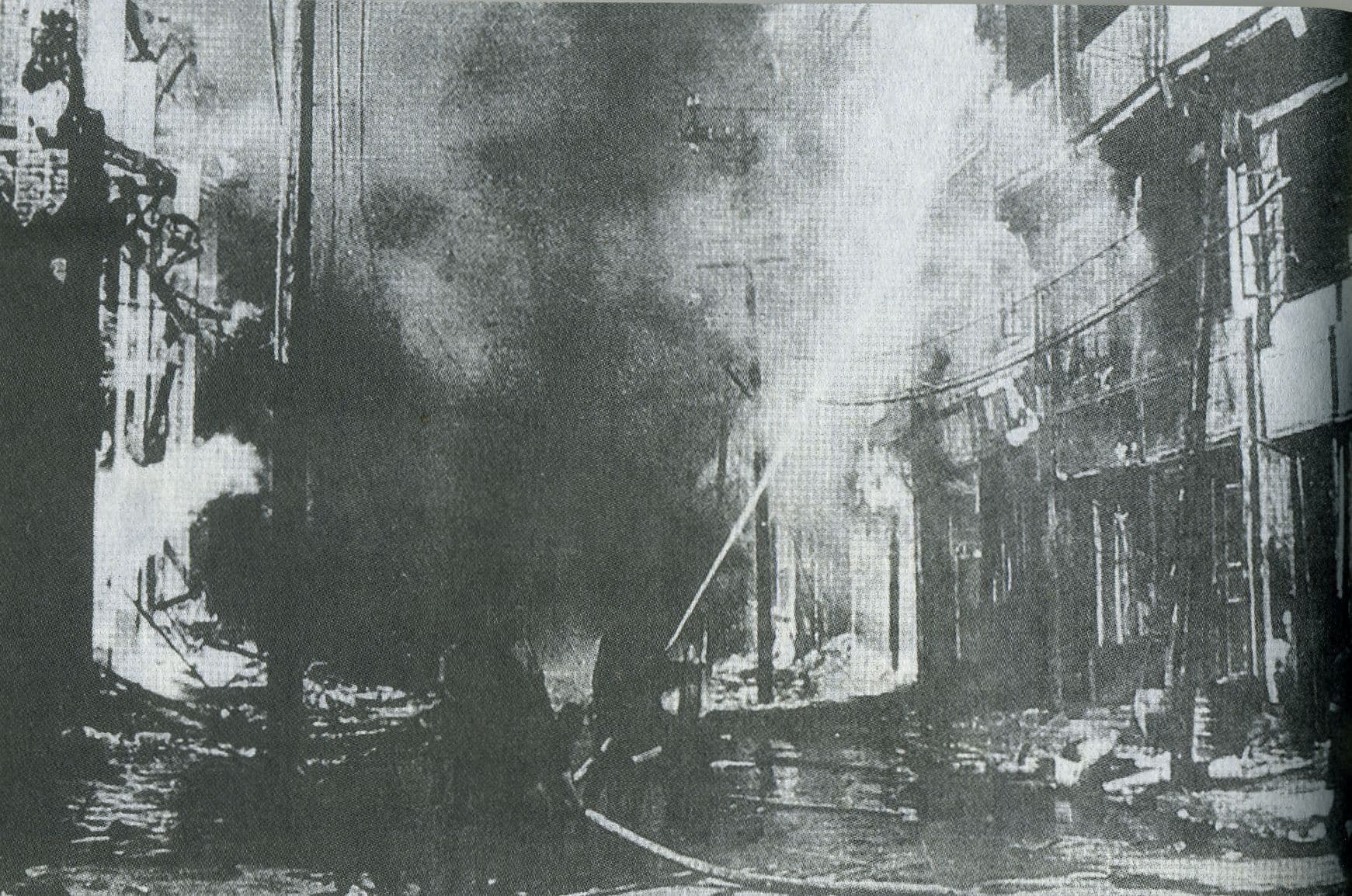
As the Nationalist government moved its capital to Chongqing, large numbers of factories, businesses, banks, schools and research institutes from the coast and the middle and lower Yangtze relocated there in early 1938, and more than 30 countries, including the Soviet Union, the United States, Britain and France, opened embassies in the city. Chongqing grew from a mid-sized regional city into the political, military, economic and cultural centre of China's wartime rear area — and for that reason Japan made it a principal bombing target. From 18 February 1938 to 19 December 1944 Japanese forces bombed central Chongqing and the surrounding districts and counties, in what became known as the Great Bombing of Chongqing. The campaign opened with a surprise raid on Guangyangba airfield on the city's outskirts in February 1938. According to Huang Xiaodong, a researcher at the Chongqing China Three Gorges Museum, the early raids concentrated on military and government targets.
The 3 and 4 May 1939 Raids
Huang says that after 3 and 4 May 1939 the Japanese bombing of Chongqing "became indiscriminate bombing." On 3 May, 63 Japanese aircraft in two waves raided the city, dropping 83 high-explosive and 36 incendiary bombs on Minquan Road, Feilaisi, Guofu Road, Xuetianwan, Lianglukou and other areas. On 4 May another 27 aircraft attacked, using large numbers of incendiaries; the fires they started were not fully put out for three days. Thirty-eight streets were hit and ten main streets, including Duyou Street, Jianjiaqiao and Chaijiaxiang, were destroyed. According to the Chongqing Daily, the raid that day killed 3,318 people and seriously injured 1,913, the highest death toll of any raid of the campaign. The Tokyo District Court's first-instance judgment of 2015 found that the raids of 3 and 4 May together killed 3,391 people and injured 2,323. After the war the Nationalist government rebuilt Jianjiaqiao, merged it with nearby Jijie and renamed it Wusi (May Fourth) Road.
Sustained Bombing and the Shelters
In 1940 Japan carried out Operation 101 against Chongqing, carpet-bombing the city; from 1941 it adopted "fatigue bombing," and residents were often kept under air-raid alert for hours, sometimes more than ten hours at a stretch. Chongqing responded by digging shelters on a massive scale. According to figures cited by the Chongqing Daily, in 1937 the city had only 54 air-raid shelters, holding some 7,000 people — just 1.51 percent of the registered population; by 1942 it had 1,603, enough to hold essentially the entire population. From 1938 the Nationalist government built a Great Air-Raid Tunnel running from Chaotianmen through Linjiangmen and Tongyuanmen to Nanjimen. Completed after two years, it was 3,722 metres long, with seven sections and 13 entrances, and could hold more than 40,000 people; its Shihuishi, Yanwuting and Shibati sections were connected underground and formed the largest-capacity section, known as the Jiaochangkou Great Tunnel.
The Great Tunnel Disaster of 5 June 1941
On the evening of 5 June 1941, 24 Japanese aircraft in three waves made a night raid on the city — the first night raid on Chongqing since the foggy season of winter 1940. The air-raid alert sounded at 18:18 and was not lifted until 23:27, a span of 5 hours 9 minutes. Because residents were used to sheltering from daytime raids, unusually many people had come into the city from the suburbs that evening, and those living on the south bank and in Jiangbei could not cross the river in time and crowded into shelters inside the city. According to research by the scholar Ying-kit Chan, more than 10,000 people packed into the Jiaochangkou tunnel, which had a capacity of roughly 4,000 to 5,000. As the oxygen ran out, people pushed toward the exits, and large numbers suffocated or were trampled to death. Guo Weibo, a trainee with the Military Affairs Commission who was inside the tunnel, recalled that the tunnel gate "closed from the inside outward" and that the crowd jammed it shut; when the all-clear came in the early hours of 6 June, the bodies carried out were piled in heaps at the entrance and took more than ten truckloads to remove.
Accounts of the death toll differ. An official Chongqing government release says the raid "indirectly caused more than 2,000 residents to die of suffocation"; Chan notes that Chinese estimates range from 992 to 12,000; and a 2025 Chongqing Daily report states that "to this day there is no settled figure" for the dead. In 2015 a research team at Southwest University led by Pan Xun, working on a national project on the Japanese army's indiscriminate bombing, published a first list of 635 victims; nearly 40 percent were under 20, and 119 were aged ten or younger.
After the disaster, newspapers and magazines carried extensive criticism of the Nationalist government's inadequate shelters and poor management. On 8 June Chiang Kai-shek, citing neglect of duty, dismissed Air Defence Commander Liu Zhi, Deputy Air Defence Commander Hu Bohan and Chongqing mayor Wu Guozhen while keeping them in their posts pending review, and ordered a full investigation. According to Chan, Chiang later acted on Wu's advice to set up a review committee, and transferred responsibility for building and managing Chongqing's air-raid facilities and shelters from the Air Defence Command to the municipal authorities.
Casualty Figures and the Lawsuit Against Japan
Because of differing methods and time spans, casualty figures for the Great Bombing vary. An official Chongqing release, citing the Chongqing Air Defence Gazetteer, says more than 24,000 people were killed or injured in the raids of 1938 to 1943 and 17,452 buildings were bombed or burned down; the Chongqing Daily reported in 2025 that six years and ten months of bombing caused 32,829 direct casualties and property losses of 10 billion yuan in fabi; Xinhua reported in 2026 that Japanese aircraft dropped more than 18,000 bombs and caused more than 32,000 direct civilian casualties. Chan's article estimates that between February 1938 and August 1943 more than 9,500 Japanese aircraft dropped about 21,600 bombs, killing about 15,000 people and injuring more than 20,000.
In April 2004 survivors formed a plaintiffs' group to seek compensation from Japan for the Great Bombing of Chongqing. On 30 March 2006, 40 victims and family representatives from Chongqing, Leshan and Zigong sued the Japanese government in the Tokyo District Court, demanding an apology and compensation; after three further filings, the plaintiffs, from Chongqing, Chengdu, Zigong, Leshan, Songpan and elsewhere, numbered 188. On 25 February 2015 the Tokyo District Court, in its first-instance judgment, acknowledged that Japanese bombing of Chongqing and other parts of Sichuan between February 1938 and August 1943 had caused civilian casualties, but rejected all claims for compensation and apology on the grounds that China had renounced state war reparations in the Sino-Japanese Joint Communiqué and that individuals lacked standing under international law. The Tokyo High Court upheld the ruling in December 2017, and the Supreme Court of Japan upheld it in the final instance in December 2019.
Gallery
Narrative Comparison
| Source | Narrative |
|---|---|
| Chongqing Daily and Xinhua reports (2025–2026) | The Chongqing Daily describes the Great Bombing as "rare in the history of human warfare" for "the length of the bombing, the number of raids, the cruelty of the methods and the depth of the disaster," and says that "the people of Chongqing never gave in, and instead grew stronger with every bombing"; it also stresses the role of the air-raid shelters in protecting residents and keeping production going. Xinhua reports that although the Japanese courts rejected the plaintiffs' claims, they found that the bombing had caused harm, which "marks the first time that Japan has, as a matter of legal fact, formally recognised the crimes committed against the people of Chongqing, Chengdu, Leshan, Zigong, Songpan and elsewhere." |
| Ying-kit Chan, International Journal of Asian Studies (2017) | Studying the Great Tunnel Disaster, Chan argues that at the time it was seen more as a human-induced "stampede" than as a Japanese "war atrocity": the Chinese public used the press to condemn the Nationalist government for failing to prevent, manage and mitigate the disaster, accusing it of callousness, incompetence and negligence, and in doing so sought to renew a traditional "social contract of disaster" under which the state was responsible for relieving victims. He also notes that the bombing's impact was uneven: ordinary residents from the middle and lower classes lacked access to the well-equipped underground shelters of senior officials and wealthy businessmen and suffered disproportionately high casualties. |
| Accounts by Theodore White and Annalee Jacoby, Han Suyin and Guo Weibo (as quoted by the Chongqing Daily) | Theodore White and Annalee Jacoby, correspondents in Chongqing for Time and Life, wrote that every terror bombs could bring fell upon the city — corpses, bloodied people, and the hundreds of thousands who could not squeeze into the shelters (quoted in Chinese translation by the Chongqing Daily). The writer Han Suyin, in Birdless Summer, described looking toward Linjiangmen and seeing a sea of fire with flames rolling over it. Guo Weibo, who survived the Great Tunnel Disaster, recalled: "As the minutes ticked by, the temperature in the tunnel rose and the oxygen ran lower … people who could bear it no longer all rushed toward the entrance at once." |
Key Milestones
- Japanese bombing of Chongqing begins
Japanese forces begin bombing central Chongqing and the surrounding area, opening with a surprise raid on Guangyangba airfield on the outskirts.
- The 3 May raid
Sixty-three Japanese aircraft in two waves raid the city, dropping 83 high-explosive and 36 incendiary bombs, as the bombing turns indiscriminate.
- The 4 May raid
Twenty-seven aircraft drop large numbers of incendiaries, destroying ten main streets; according to the Chongqing Daily, 3,318 people are killed that day.
- The Great Tunnel Disaster
A Japanese night raid keeps the city under alert for 5 hours 9 minutes; large numbers of people sheltering in the Jiaochangkou tunnel suffocate or are trampled to death.
- Liu Zhi, Hu Bohan and Wu Guozhen disciplined
Chiang Kai-shek, citing neglect of duty, dismisses Air Defence Commander Liu Zhi, his deputy Hu Bohan and Chongqing mayor Wu Guozhen while keeping them in post, and orders an investigation.
- The bombing of Chongqing ends
According to Xinhua, the Japanese bombing of central Chongqing and its surroundings ends on this date.
- Victims sue the Japanese government in Tokyo
Forty victims and family representatives from Chongqing, Leshan and Zigong file suit in the Tokyo District Court, demanding an apology and compensation.
- Tokyo District Court ruling
The court acknowledges that the bombing caused civilian casualties but rejects all claims for compensation and apology by the 188 plaintiffs.
Last verified:
Cite this page
Chronicles of Modern China. (2026, November 3). Bombing of Chongqing. Retrieved November 3, 2026, from https://www.cmcarchive.org/events/bombing-of-chongqing-1938
“Bombing of Chongqing.” Chronicles of Modern China. Last modified November 3, 2026. Accessed November 3, 2026. https://www.cmcarchive.org/events/bombing-of-chongqing-1938.
Chronicles of Modern China. Bombing of Chongqing[EB/OL]. (2026-11-03)[2026-11-03]. https://www.cmcarchive.org/events/bombing-of-chongqing-1938.