First Session of the 14th National People's Congress
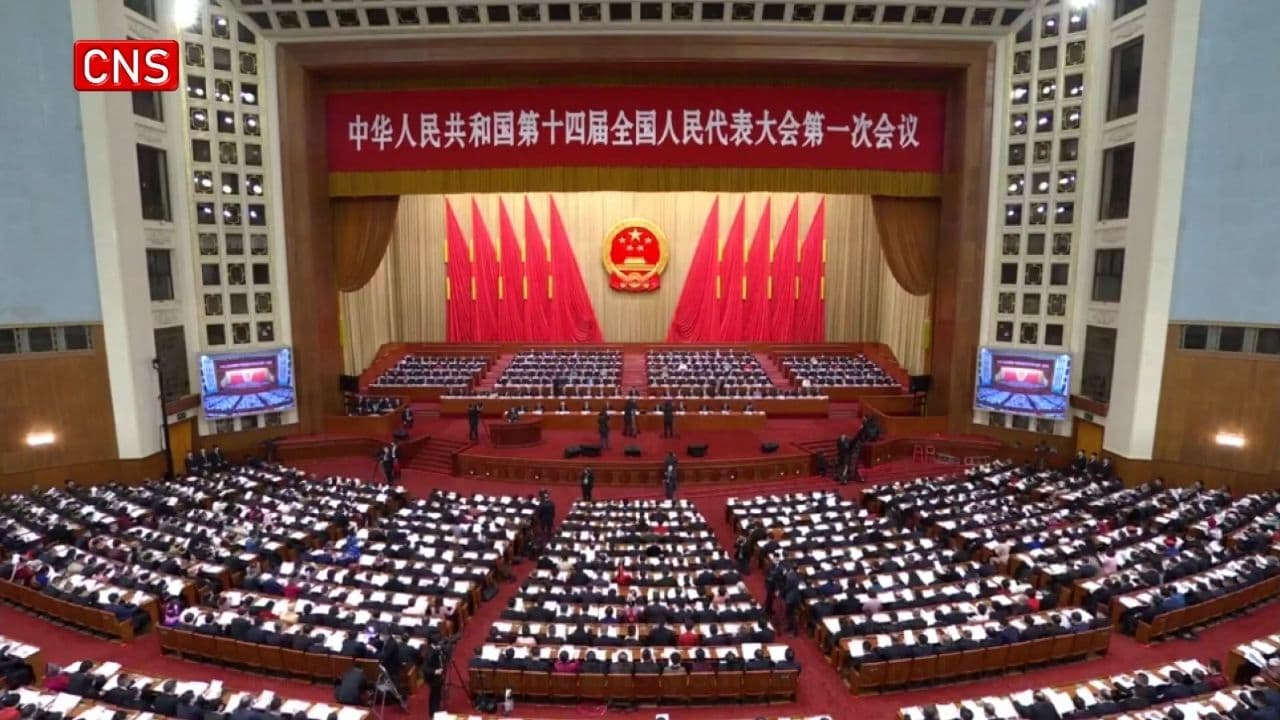
The First Session of the 14th National People's Congress met in Beijing from 5 to 13 March 2023. Xi Jinping was elected President and Chairman of the Central Military Commission with all 2,952 votes, the first President to serve a third term since the 1982 Constitution, and Li Qiang succeeded Li Keqiang as Premier. The session approved the ninth round of State Council restructuring of the reform era, and the Party and state reform plan published soon after created Party bodies such as the Central Financial Commission and the Central Science and Technology Commission.
Background
In March 2018 the First Session of the 13th National People's Congress adopted a constitutional amendment deleting the rule that the President and Vice-President "shall serve no more than two consecutive terms". After the CCP's 20th National Congress in October 2022, Xi Jinping was elected General Secretary for a third time at the First Plenary Session of the 20th Central Committee; in February 2023 the Second Plenary Session adopted the Plan for Reforming Party and State Institutions and put forward its nominations for state leadership posts to the NPC.
The Session
The First Session of the 14th NPC opened in Beijing on 5 March 2023. That day Premier Li Keqiang delivered his last government work report, setting targets for 2023 including GDP growth of around 5%, around 12 million new urban jobs and consumer price inflation of around 3%.
On 10 March the session elected Xi Jinping President and Chairman of the Central Military Commission. Of 2,977 deputies due to attend, 2,952 were present, and Xi received all 2,952 votes in both elections, beginning his third term as President — the first time since the 1982 Constitution took effect that a President had been elected to a third term. The same day the session elected Zhao Leji Chairman of the NPC Standing Committee and Han Zheng Vice-President, and approved the State Council institutional reform plan. The newly elected leaders took the constitutional oath.
On 11 March, on Xi's nomination, the session appointed Li Qiang Premier, succeeding Li Keqiang. On 12 March, on Li Qiang's nomination, it appointed Ding Xuexiang, He Lifeng, Zhang Guoqing and Liu Guozhong Vice Premiers and Li Shangfu, Wang Xiaohong, Wu Zhenglong, Shen Yiqin and Qin Gang State Councilors.
The session closed on 13 March after adopting a decision amending the Legislation Law. In his closing speech Xi said the people's trust was "the greatest motivation for me to move forward and also a weighty responsibility on my shoulders", and stressed that from now to the middle of the century building a great modern socialist country and advancing national rejuvenation was the central task of the whole Party and nation: "the baton of building a strong country and achieving national rejuvenation has historically fallen to our generation". He also called for upholding the one-China principle and the "1992 Consensus", resolutely opposing external interference and "Taiwan independence" separatist activities, and advancing the reunification of the motherland. Li Qiang held his first premier's press conference the same day.
Party and State Institutional Reform
The State Council reform plan approved by the session was the ninth round of State Council restructuring since the start of reform and opening. Its main elements included reorganising the Ministry of Science and Technology, transferring some of its planning and management functions to the National Development and Reform Commission, the Ministry of Industry and Information Technology, the Ministry of Agriculture and Rural Affairs and others; creating the National Financial Regulatory Administration on the basis of the China Banking and Insurance Regulatory Commission, to oversee all financial sectors except securities; turning the China Securities Regulatory Commission from a public institution into an agency directly under the State Council; creating a National Data Administration under the National Development and Reform Commission; and folding the National Rural Revitalisation Administration's functions into the Ministry of Agriculture and Rural Affairs.
On 16 March the CCP Central Committee and the State Council published the full Plan for Reforming Party and State Institutions, which created Party bodies including the Central Financial Commission, the Central Financial Work Commission, the Central Science and Technology Commission, the Central Social Work Department and the Hong Kong and Macao Work Office, abolished the State Council's Financial Stability and Development Committee and moved its functions to the office of the Central Financial Commission; central-level reforms were to be completed by the end of 2023 and local ones by the end of 2024.
Gallery
Narrative Comparison
| Source | Narrative |
|---|---|
| Chinese official position (Xinhua reports, Xi's closing speech, the reform plans) | The session elected the new leadership of state institutions in accordance with the law; Xi Jinping's unanimous election as President and CMC Chairman reflected the common wish of the people of all ethnic groups. From now until mid-century the central task is to build a great modern socialist country and advance national rejuvenation, and the baton has fallen to this generation. The deepening of Party and state institutional reform takes strengthening the Party Central Committee's centralised and unified leadership as its overarching principle and modernising governance as its aim, optimising institutional functions in key areas such as science and technology, financial regulation, data management and rural revitalisation to provide a strong guarantee for building a modern socialist country. |
| Overseas research analysis (NPC Observer, Changhao Wei, 2023) | NPC Observer, a research site that tracks the National People's Congress, noted that this was the ninth round of State Council reorganisation since the start of the reform era — after 1982, 1988 and every five years thereafter — altering the functions of about a dozen agencies and creating two new ones. It cautioned that the as-yet unpublished overall plan for Party and state institutions could have larger implications for the State Council, either by creating new Party entities to oversee State Council agencies or, as in 2018, by turning some State Council agencies into Party entities — changes that need no NPC approval so long as they do not reorganise the so-called constituent departments of the State Council. The plan published soon after duly created Party bodies such as the Central Science and Technology Commission, with the Ministry of Science and Technology serving as its administrative office. |
Key Milestones
- Session opens; Li Keqiang's last work report
Li Keqiang's government work report set a 2023 GDP growth target of around 5% among other goals.
- Xi unanimously elected President
Xi Jinping was elected President and CMC Chairman with all 2,952 votes, beginning a third term; Zhao Leji became NPC Standing Committee chairman and Han Zheng Vice-President; the State Council reform plan was approved.
- Li Qiang appointed Premier
On Xi's nomination the session appointed Li Qiang Premier.
- Other State Council members appointed
Ding Xuexiang, He Lifeng, Zhang Guoqing and Liu Guozhong became Vice Premiers; Li Shangfu, Wang Xiaohong, Wu Zhenglong, Shen Yiqin and Qin Gang State Councilors.
- Session closes; Legislation Law amended
The session amended the Legislation Law; Xi spoke at the closing and Li Qiang held his first premier's press conference.
- Party and state reform plan published
The Central Committee and State Council issued the Plan for Reforming Party and State Institutions, creating Party bodies such as the Central Financial Commission and Central Science and Technology Commission.
Last verified:
Cite this page
Chronicles of Modern China. (2026, November 2). First Session of the 14th National People's Congress. Retrieved November 2, 2026, from https://www.cmcarchive.org/events/14th-npc-first-session-2023
“First Session of the 14th National People's Congress.” Chronicles of Modern China. Last modified November 2, 2026. Accessed November 2, 2026. https://www.cmcarchive.org/events/14th-npc-first-session-2023.
Chronicles of Modern China. First Session of the 14th National People's Congress[EB/OL]. (2026-11-02)[2026-11-02]. https://www.cmcarchive.org/events/14th-npc-first-session-2023.