Three Gorges Dam Reaches Full Capacity
The world's largest hydropower project, built over more than a decade, displaced approximately 1.3 million people from 13 cities, 140 towns, and 1,350 villages; with a generating capacity of 22,500 megawatts, it also serves flood control and navigation functions, but has caused irreversible ecological damage and has been linked to increased seismic activity in the reservoir area.
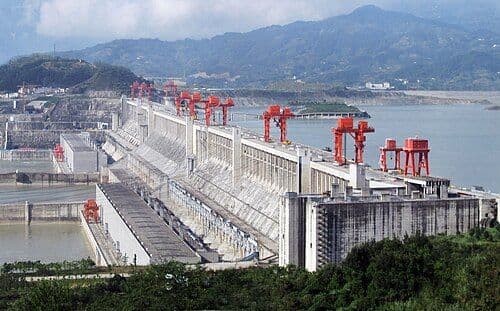
A Century-Long Dream
The idea of damming the Yangtze at the Three Gorges had been proposed as early as the 1910s. Sun Yat-sen advocated it, and Mao Zedong wrote a famous poem about it. Construction began in 1994 after decades of debate and feasibility study. The project required relocating 1.3 million people from 13 cities, 140 towns, and 1,350 villages submerged by the rising reservoir. The main dam structure was completed in May 2006 and the reservoir reached its designed level of 175 metres in 2010.
Engineering Achievement and Criticism
At 2,335 metres long and 185 metres high, the Three Gorges Dam is the world's largest hydropower facility, with a generating capacity of 22,500 megawatts — equivalent to 15 nuclear power plants. It also provides flood control for the middle and lower Yangtze, a historically flood-prone region. Critics, however, documented massive forced displacement often with inadequate compensation, the irreversible loss of archaeological and natural heritage, increased landslide risk along the reservoir banks, and disruption of the Yangtze ecosystem including the functional extinction of the Yangtze river dolphin (baiji), declared by an international expedition in 2006.
Environmental Consequences
The dam has been linked to increased seismic activity in the reservoir area, as the weight of water causes geological stress. The reservoir's slow-flowing waters accumulate agricultural and industrial pollutants. Reduced sediment flow downstream has accelerated coastal erosion at the Yangtze Delta. The Yangtze finless porpoise and Chinese sturgeon have been pushed further toward extinction. In 2020, severe flooding in the Yangtze basin raised questions about the dam's flood-control effectiveness under climate change conditions.
Narrative Comparison
| Source | Narrative |
|---|---|
| PRC Official Narrative | The Three Gorges Project was a major strategic deployment decided upon by the Party Central Committee and the State Council with scientific judgement and at the right moment in history — a concentrated embodiment of the spirit of self-reliance and hard struggle of the Chinese people under the leadership of the Communist Party of China. The project's construction spanned more than a decade, overcoming countless world-class technical challenges and setting multiple world records in hydraulic engineering. The Three Gorges Project delivers three integrated benefits: flood control, power generation, and navigation. It has effectively safeguarded the lives and property of tens of millions of people in the middle and lower Yangtze reaches, provides approximately 100 billion kilowatt-hours of clean electricity annually, and has significantly improved navigability on the Sichuan reaches of the Yangtze. The resettlement of migrants was an integral part of the project; the Party and government invested enormous human and material resources to ensure the appropriate resettlement of 1.3 million migrants and the improvement of their living and production conditions. The successful construction and operation of the Three Gorges Project is powerful evidence of the superiority of the socialist system with Chinese characteristics in concentrating resources to accomplish major undertakings, and represents an important contribution by China to global efforts to address climate change and reduce carbon emissions. |
| Western Academic Analysis | Western and international scholarly assessment of the Three Gorges Project has concentrated on several dimensions. The first concerns the costs of resettlement: Patrick McCully and other scholars have noted that a large proportion of the 1.3 million resettled migrants experienced inadequate compensation, forced relocation, and declining livelihoods after resettlement, particularly agricultural migrants relocated to infertile hillside land. The second concerns the irreversibility of ecological costs: the impoundment directly contributed to the declaration of functional extinction of the Yangtze river dolphin (baiji) in 2006, while populations of the Chinese sturgeon and Yangtze finless porpoise have continued to decline; the reservoir's interception of sediment has altered downstream hydrological patterns and accelerated coastal erosion at the Yangtze Delta. The third concerns geological and climatic risks: the frequency of induced seismic events in the reservoir area has risen since the dam's completion, and during the major Yangtze flooding of 2020, dam deformation data and flood progression raised questions in international commentary about the dam's flood-control capacity under conditions of extreme climate events. The fourth is an institutional analysis of the decision-making process: in the 1992 National People's Congress vote, the Three Gorges resolution received an unusually high rate of opposition votes by the standards of China's legislature — 177 against and 664 abstentions — which scholars have treated as a paradigmatic case for understanding the political decision-making mechanisms of major infrastructure projects in China. |
Key Milestones
- NPC Approves Three Gorges Project; 177 Votes Against, 664 Abstentions
On 3 April 1992, the Fifth Session of the Seventh National People's Congress passed the Resolution on the Construction of the Yangtze Three Gorges Project by 1,767 votes in favour, 177 against, 664 abstentions, and 25 non-votes. The number of opposing and abstaining votes was highly unusual by the standards of NPC voting, reflecting the deep reservations of delegates regarding the project's scale, the resettlement of migrants, and its ecological impact.
- Three Gorges Project Construction Formally Begins; Jiang Zemin Attends Groundbreaking
On 14 December 1994, the formal groundbreaking ceremony for the Three Gorges Project was held at Sandouping in Yichang, Hubei; State President Jiang Zemin attended and announced the formal commencement of construction. The first phase of the project encompassed cofferdaming and river closure, construction of the diversion channel, and excavation of the dam foundations, with a planned construction period of 17 years and a total investment of approximately 95.4 billion yuan at prices of the time.
- Reservoir First Impounded to 135 Metres; First Generating Units Commissioned
On 1 June 2003, the Three Gorges reservoir began its first impoundment; by 10 June the water level had risen to 135 metres, marking the completion of the second phase of construction and the entry of the dam into initial operation. In late June, the first two generating units were commissioned and the Three Gorges Project began producing electricity. The relocation of migrants from the reservoir inundation zone had by this point been substantially completed.
- Main Dam Structure Completed; Final Concrete Pour Finished
On 20 May 2006, the main structure of the Three Gorges Dam was completed in its entirety, with the final concrete pour finished and the dam crest reaching its designed elevation of 185 metres above sea level, marking the formal conclusion of a building programme spanning more than a decade and employing millions of workers. The reservoir water level at this point remained at 156 metres; further impoundment trials were required before reaching the designed storage level of 175 metres.
- Reservoir First Reaches Designed Level of 175 Metres; Project Fully Operational
On 26 October 2010, the Three Gorges reservoir water level reached its designed normal storage level of 175 metres for the first time, marking the formal attainment of full operational capacity after several years of phased impoundment trials. From this point, the Three Gorges Project was able simultaneously to deliver its three designed benefits — flood control, power generation, and navigation improvement — under design operating conditions, entering full operational status.
Last verified: