Peaceful Liberation of Beiping
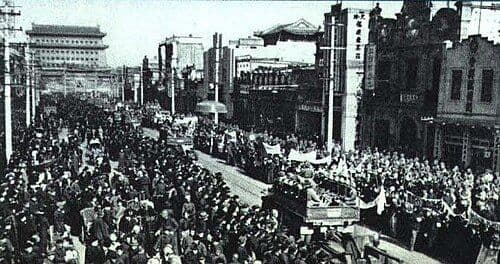
On 31 January 1949, General Fu Zuoyi surrendered Beiping to the People's Liberation Army without armed resistance, preserving the ancient capital's historical fabric and delivering a decisive blow to the Nationalist cause.
Background
By January 1949, the balance of forces on the Chinese mainland had decisively shifted in favour of the Communist-led People's Liberation Army. Following the PLA's victories at the Liaoshen and Huaihai campaigns — two of the three decisive battles of the Civil War — and as the Pingjin Campaign was nearing its conclusion, the Nationalist government's military capacity was effectively broken.
Beiping (present-day Beijing), garrisoned by some 200,000 Nationalist troops under General Fu Zuoyi, was surrounded by PLA forces. Fu faced a stark choice: fight and risk the destruction of one of the world's most historically rich cities, or negotiate a peaceful handover.
Negotiation and Handover
Secret negotiations between Fu Zuoyi and CPC representatives, facilitated in part by Fu's daughter Fu Dongju — a clandestine Communist Party member — resulted in an agreement for a peaceful transition. On 31 January 1949, PLA troops entered Beiping without firing a shot.
The preservation of Beiping's palaces, temples, and hutongs stood in deliberate contrast to the destruction wrought elsewhere in the Civil War. Mao Zedong and the CPC leadership would enter the city in March 1949, and it was renamed Beijing ("Northern Capital") following the founding of the PRC.
Significance
The peaceful liberation of Beiping became a template the CPC used to encourage other Nationalist commanders to surrender without resistance. It also demonstrated that the new government intended to preserve China's cultural heritage — a message of continuity alongside revolution.
Fu Zuoyi himself was rewarded for his cooperation, serving as Minister of Water Resources in the PRC government until 1974.
Narrative Comparison
| Source | Narrative |
|---|---|
| PRC Official Narrative | General Fu Zuoyi answered the call of history and led his troops in an uprising, peacefully transferring Beiping to the People's Liberation Army and sparing this irreplaceable historic city from destruction. His patriotic decision saved hundreds of thousands of soldiers and civilians from the ravages of war and set a shining example for Nationalist forces elsewhere to follow in seeking a peaceful resolution. The Communist Party recognised General Fu's historic contribution and appointed him Minister of Water Resources, uniting him with the new China he helped to bring about. |
| Republic of China / Taiwan Historical Assessment | General Fu Zuoyi, as an officer of the Republic of China, entered into secret negotiations with the Communists without authorisation from the central government and surrendered his troops, positions, and military intelligence wholesale. In doing so, he violated his oath of loyalty to the Republic and denied hundreds of thousands of soldiers the chance to continue their lawful resistance. Fu's unilateral capitulation accelerated the complete collapse of Nationalist resistance in North China and constitutes an act of betrayal against the Republic of China. |
| Western Academic Assessment | Scholars broadly view Fu Zuoyi's decision as pragmatic rather than ideological. Facing encirclement by overwhelming PLA forces, he negotiated a bloodless transfer that preserved both the city and his troops. The role of his daughter Fu Dongju — a covert CPC member — in facilitating the negotiations is well-documented, though the extent of her influence remains debated. (Westad, 2003; Lew, 2009) |
Key Milestones
- Tianjin Falls
PLA forces under General Liu Yalou capture Tianjin after 29 hours of fierce urban combat, eliminating the last viable military option for Fu Zuoyi and leaving Beiping isolated.
- Peace Agreement Signed
Fu Zuoyi and CPC representatives sign the formal agreement for the peaceful handover of Beiping. His daughter Fu Dongju, a covert CPC member, played a key role in facilitating the negotiations.
- PLA Enters Beiping
PLA troops march into Beiping without firing a shot. The ancient city — its palaces, temples, hutongs, and population of over one million — is preserved intact. The civil war in North China ends.
- CPC Central Committee Enters Beiping
Mao Zedong and the CPC Central Committee relocate from Xibaipo to Beiping, making it the political centre of the soon-to-be-proclaimed People's Republic. The city will be renamed Beijing ("Northern Capital") in September.
Last verified: