Nanjing Massacre
Following the fall of Nanjing on 13 December 1937, Japanese Imperial Army forces conducted six to eight weeks of systematic killing, mass rape, and looting in and around the Chinese Nationalist capital. The event is one of the most documented atrocities of the Second World War and one of the most contested historical episodes in Sino-Japanese relations, with casualty estimates ranging from 40,000 to over 300,000.
The Fall of Shanghai and the March on Nanjing
The Nanjing Massacre was the culmination of the Japanese campaign to seize China's capital following the Battle of Shanghai (13 August – 26 November 1937). The three-month battle for Shanghai — the most intense urban combat of the war — had cost the Chinese an estimated 250,000 to 300,000 casualties and devastated the best-trained and equipped units of the Nationalist army. The fall of Shanghai left Nanjing, 300 kilometres to the west, directly exposed.
Chiang Kai-shek faced a difficult decision: whether to defend Nanjing to the last or withdraw the government and surviving forces. Most senior commanders advised abandonment; Tang Shengzhi, the general who ultimately commanded Nanjing's defence, was one of the few who argued for holding the city. Chiang chose a politically necessary but militarily inadequate compromise: a defence that would demonstrate will but could not be sustained. The Nationalist government formally relocated to Wuhan and then Chongqing. Japanese forces converged on Nanjing from multiple directions in early December.
The Massacre
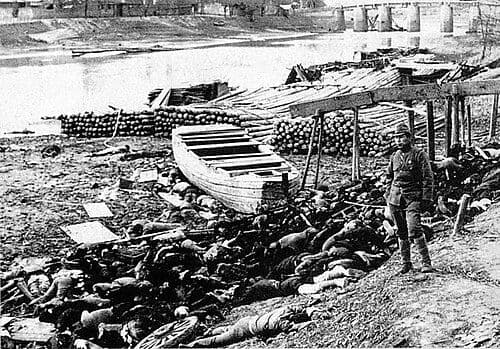
On 13 December 1937, Japanese forces entered Nanjing. What followed over the next six to eight weeks is attested by multiple independent sources: diary entries and reports by German Nazi Party member John Rabe, who served as chairman of the International Safety Zone; diaries of American missionary Minnie Vautrin at Ginling Women's College; reports from American diplomat George Fitch; Tokyo War Crimes Tribunal testimony; and Japanese military records and private diaries. Collectively, these sources document mass executions of prisoners of war and civilians, systematic rape on a massive scale, and widespread looting and arson.
Rabe and other foreign residents established the Nanjing Safety Zone — a roughly 3.8-square-kilometre area in the western part of the city — which sheltered an estimated 200,000 to 250,000 Chinese civilians. Vautrin's Ginling College alone sheltered over 10,000 women and children. Despite their efforts, Japanese soldiers repeatedly entered the zone to remove men for execution and assault women.
Casualty Estimates and the Contested Record
No aspect of the Nanjing Massacre is more contested than the death toll. The People's Republic of China officially states "300,000 or more." This figure was established by the Tokyo War Crimes Tribunal (1946–48), which accepted it as a minimum. The Memorial Hall for the Victims of the Nanjing Massacre, opened in 1985, inscribes this number on its exterior wall. Chinese state commemorations consistently use this figure.
Mainstream Japanese historians — including those at the Center for Research and Documentation on Japan's War Responsibility — generally accept a range of 100,000 to 200,000. Japanese nationalist and revisionist historians dispute the massacre's scale, with estimates ranging from zero to 40,000, and some argue the killings were lawful reprisals against combatants rather than atrocities against civilians. Western academic consensus, drawing on methodological analysis of the available sources, centres on 100,000 to 200,000, with Iris Chang's widely read but methodologically contested The Rape of Nanking (1997) adopting the 300,000 figure.
Historical Memory and Sino-Japanese Relations
The Nanjing Massacre has been a persistent flashpoint in Sino-Japanese relations since the 1970s, when it first received sustained attention in Japanese public discourse. Repeated controversies have erupted over Japanese government officials' visits to Yasukuni Shrine (which enshrines convicted war criminals), the content of Japanese history textbooks, and statements by politicians minimising or denying the massacre. China has used the massacre as a central element in its narrative of Japanese imperialism and wartime aggression.
In 2015, UNESCO accepted documents related to the Nanjing Massacre into its Memory of the World Register, a decision Japan formally protested. The massacre's political salience in contemporary China-Japan relations means that the historical evidence continues to be interpreted through deeply politicised lenses on both sides.
Narrative Comparison
| Source | Narrative |
|---|---|
| PRC Official Narrative | Japanese imperialist aggressors occupied Nanjing on 13 December 1937 and for six weeks perpetrated a systematic massacre of Chinese civilians and prisoners of war. More than 300,000 of our compatriots were slaughtered — a crime against humanity without parallel in the modern history of warfare. This history must never be forgotten and must never be denied. History is not open to negotiation. Those who seek to minimise, distort, or erase the Nanjing Massacre are desecrating the memory of the victims and insulting the conscience of humanity. China demands sincere remorse and a responsible reckoning with this history from Japan. |
| Japanese Historical Debate | Within Japan, three broad positions exist. Mainstream academic historians (e.g., Kasahara Tokushi, Yoshida Takashi) accept a death toll in the range of 100,000–200,000 and classify the events unambiguously as a massacre. A "middle school" of historians accepts a lower figure (around 40,000–100,000) but still recognises illegal killings occurred. Nationalist-revisionist historians deny or minimise the massacre, disputing the definition of the "Nanjing area," the combatant/civilian distinction, and the reliability of Chinese and Western sources. Government officials' statements have at various times reflected all three positions, creating recurring diplomatic crises. |
| Western Academic Assessment | Western historians generally accept a death toll of 100,000–200,000, based on methodological analysis of burial records, contemporary accounts, and demographic data. Scholars such as Timothy Brook, Bob Wakabayashi, and contributors to the "Nanking 1937" volume (2007) have attempted to move beyond the politicised debate over numbers toward more granular analysis of specific incidents, command responsibility, and the role of ideology in enabling the violence. The International Safety Zone records maintained by Rabe and Vautrin are considered among the most reliable contemporaneous documentation. |
| Republic of China Official Position | The Nanjing Massacre was an act of military barbarism committed by Japanese imperial forces against the soldiers and people of the Republic of China. Following the collapse of the Nanjing defence on 13 December 1937, Japanese forces perpetrated six weeks of systematic killing, rape, and looting against both surrendered combatants and non-combatant civilians — acts categorically prohibited under the laws of war. The Republic of China government participated in the International Military Tribunal for the Far East, where Japanese commanders were held accountable for these crimes. The evidentiary record — drawn from ROC government archives, foreign diplomatic reports, and Tokyo Tribunal proceedings — establishes the historical facts beyond reasonable dispute. These crimes were committed against the constitutional government and people of the Republic of China, and the responsibility of the Japanese imperial military is a matter of established historical and legal record. |
| International Safety Zone Eyewitness Records | What the International Safety Zone Committee documented between December 1937 and February 1938 was systematic, not incidental. John Rabe's daily reports to the Japanese Embassy recorded hundreds of individual cases — men taken from the zone and killed, women assaulted despite repeated diplomatic protest. Minnie Vautrin's diary, kept night by night at Ginling Women's College, recorded the names of women she could not protect and the gates she held against armed soldiers with her own body. Lewis Smythe's systematic house-to-house survey (February–March 1938) documented a minimum of 12,000 civilians killed within the city and 26,000 in the surrounding county — figures considered a floor, as many deaths went unrecorded. These records were compiled at the time, by people who were present, and transmitted to governments and the press while the killing was still ongoing. The documentary record is not a retrospective reconstruction — it was created in real time. |
Key Milestones
- Fall of Shanghai
After nearly four months of intense fighting, Japanese forces complete the capture of Shanghai. The road to Nanjing lies open.
- Japanese Forces Begin Siege of Nanjing
Japanese forces converge on Nanjing from multiple directions. The Nationalist government has relocated to Wuhan.
- International Safety Zone Committee Established
A group of foreign nationals — diplomats, missionaries, and businesspeople — formally establish the International Committee for the Nanking Safety Zone, with German businessman John Rabe elected as chairman. The committee notifies the Japanese military of the zone's boundaries on the same day. When Nanjing falls on 13 December, the zone becomes the primary refuge for the civilian population; at its peak it shelters an estimated 200,000 to 250,000 people. Minnie Vautrin manages the Ginling Women's College compound within the zone, which alone shelters over 10,000 women and children.
- Tang Shengzhi Issues Disorganised Withdrawal Order
With Japanese forces breaching the city walls, garrison commander Tang Shengzhi issued a withdrawal order with no orderly evacuation plan in place. Soldiers stripped off their uniforms and fled into the civilian population. The collapse of organised resistance left large numbers of men identifiable to Japanese troops as former combatants hiding among civilians — a condition historians consider a significant factor in the scale of the subsequent killings.
- Fall of Nanjing — Massacre Begins
Japanese forces enter Nanjing. The massacre and mass rape of civilians and prisoners of war begins and continues for six to eight weeks.
Last verified: