May Fourth Movement
Beginning on 4 May 1919, Chinese students demonstrated across major cities to protest the transfer of German concessions in Shandong to Japan under the Treaty of Versailles — a perceived national humiliation. The movement catalysed a broader cultural revolution that dismantled traditional Confucian values, promoted science and democracy, and laid the intellectual groundwork for the founding of the Chinese Communist Party two years later.
The Paris Peace Conference and National Humiliation
China entered the First World War on the Allied side in 1917, contributing 140,000 labourers to the Western Front with the expectation that loyalty to the Allies would be rewarded at the peace table. The Chinese delegation arrived at the Paris Peace Conference in January 1919 with three core demands: return of German concessions in Shandong Province; abrogation of Japan's Twenty-One Demands (1915), which had imposed humiliating economic and political conditions on China; and an end to the unequal treaty system.
All three demands were rejected. Under Article 156 of the Versailles Treaty, Germany's rights in Shandong — including Qingdao and the Jiaozhou-Jinan Railway — were transferred directly to Japan rather than returned to China. The decision was driven in part by secret agreements Japan had reached with Britain, France, and Italy during the war, and in part by China's domestic weakness under the fractured Beiyang government. News of the settlement reached Beijing on 2 May 1919 and triggered immediate outrage among students and intellectuals.
The Demonstrations
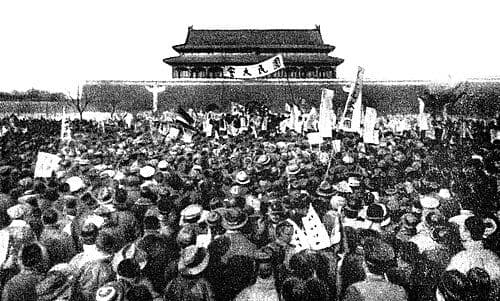
On the afternoon of 4 May, some 3,000 students from thirteen Beijing universities gathered in front of Tiananmen Gate and marched toward the Legation Quarter, demanding to present their petition to foreign ministers. Blocked, a contingent broke away to the home of Cao Rulin, the pro-Japanese official who had negotiated the Twenty-One Demands. The building was ransacked and set alight; Zhang Zongxiang, another official accused of collaboration, was beaten. The government arrested over thirty students, triggering a further escalation.
Within weeks, the protests spread far beyond Beijing. Students in Shanghai, Nanjing, Wuhan, Tianjin, and dozens of other cities went on strike. On 5 June, Shanghai workers joined, launching a general strike that paralysed the city for weeks — one of the first large-scale coordinated labour actions in Chinese history. The Beiyang government, facing both domestic pressure and diplomatic embarrassment, released the arrested students and dismissed the three pro-Japanese officials. On 28 June 1919, China's delegates in Paris refused to sign the Versailles Treaty — the first time China had ever rejected an international agreement as unjust.
The New Culture Movement
May Fourth did not emerge in isolation. It was the political flashpoint of a broader New Culture Movement that had been building since roughly 1915, centred on journals such as Chen Duxiu's La Jeunesse (新青年) and associated with figures including Hu Shi at Peking University and Lu Xun. This movement rejected classical Chinese as the medium of intellectual life and promoted the vernacular (白话); attacked Confucianism as an obstacle to modernity; and debated Western political philosophies — liberalism, anarchism, and increasingly Marxism — as alternatives to China's intellectual tradition.
The Russian Revolution of 1917 had provided a galvanising model: a semi-peripheral country had overthrown its old order and apparently broken free from Western imperialism through radical action. Li Dazhao, the Peking University librarian and one of China's earliest Marxists, hired the young Mao Zedong as a library assistant during this period. The intellectual ferment of 1919 accelerated the formation of Marxist study groups across China, directly prefiguring the founding of the Chinese Communist Party in 1921.
Legacy and Contested Meaning
May Fourth is claimed by both the People's Republic and the Republic of China as a founding moment, but with divergent emphases. The PRC stresses its revolutionary character — the awakening of the masses against imperialism and feudalism — and designates 4 May as Youth Day. The Communist Party traces its intellectual lineage directly to May Fourth: Chen Duxiu, the movement's most prominent figure, became the CPC's first General Secretary. Taiwan's interpretation, without abandoning the patriotic narrative, places greater emphasis on the movement's liberal and democratic dimensions — the calls for science and individual rights — that the PRC has since suppressed.
Narrative Comparison
| Source | Narrative |
|---|---|
| PRC Official Narrative | May Fourth is the founding moment of China's revolutionary awakening — a patriotic anti-imperialist uprising in which the people rose against both domestic feudalism and foreign imperialism. The movement's direct line to the founding of the CPC is central: Chen Duxiu and Li Dazhao are celebrated as proto-Communist heroes. The movement's cultural radicalism (rejection of Confucianism, promotion of Marxism) is emphasised over its liberal dimensions. |
| Republic of China / Taiwan Historical Assessment | May Fourth was a patriotic awakening, and more than that: a call for democracy and science as the twin foundations of national renewal. The movement's true legacy is the aspiration for individual liberty, constitutional government, and an open intellectual culture — Mr Democracy and Mr Science. This legacy was fulfilled not by the Leninist party-state that appropriated the movement's language, but by the Republic of China on Taiwan, which has built a free and democratic society that honours what the generation of 1919 actually demanded. May Fourth belongs to the democratic tradition, not to the vanguard party that turned China's intellectual renewal into an instrument of ideological control. |
| Western Academic Assessment | Western scholars situate May Fourth within broader comparative frameworks of anti-colonial nationalism and intellectual modernisation. Chow Tse-tsung's foundational study (1960) and subsequent work by Vera Schwarcz emphasise the movement's internal pluralism — liberal, anarchist, and Marxist strands coexisted — and its ambivalent relationship to Chinese tradition. Scholars note that the subsequent CPC monopoly on the May Fourth legacy has systematically suppressed the movement's liberal and individualist dimensions. |
Key Milestones
- Paris Peace Conference opens
China attends as a victorious Allied power, presenting demands to recover Shandong Province — seized by Germany in 1898 and occupied by Japan since 1914 — and to abolish unequal treaties.
- Shandong awarded to Japan
News reaches China that the Big Three (Wilson, Lloyd George, Clemenceau) have agreed to transfer Germany's Shandong concessions to Japan, honouring secret treaties and Japan's 1915 Twenty-One Demands. The Chinese delegation's appeals are rejected.
- Student demonstration in Beijing
Around 3,000 students from thirteen Beijing universities march from Tiananmen to the foreign legation quarter. Frustrated by blocked access, they march to the residence of Cao Rulin (a pro-Japanese official), burning it and beating Zhang Zongxiang. Thirty-two students are arrested.
- Student strikes spread; merchant boycotts begin
Student strikes spread beyond Beijing to Shanghai, Tianjin, and other cities. Shanghai merchants begin boycotting Japanese goods, marking the first time merchant and worker organisations join the movement.
- Mass arrests trigger general strike
Beijing authorities arrest over 900 students in two days. The crackdown triggers a general strike across Shanghai involving workers and merchants, transforming the student protest into a broad national movement.
- Three pro-Japanese officials dismissed
Under sustained public pressure, the Beiyang government dismisses Cao Rulin, Zhang Zongxiang, and Lu Zongyu — the three officials most associated with capitulation to Japan — marking the movement's first concrete political victory.
- China refuses to sign the Treaty of Versailles
The Chinese delegation in Paris — under instructions from Beijing and facing mass protests at home — refuses to sign the Treaty of Versailles, the first time China had rejected a major international settlement imposed on it by the great powers.
Last verified: