Falun Gong Suppression
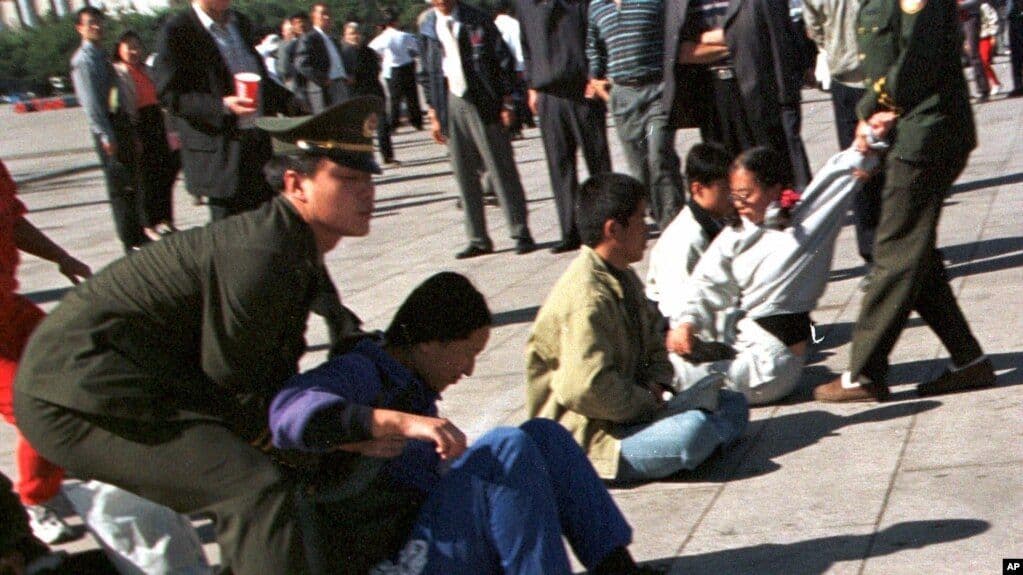
In July 1999, the Chinese government declared Falun Gong an illegal "evil cult" and launched a nationwide suppression campaign coordinated by the extra-legal 610 Office. The crackdown involved mass arrests, labour camp detention without trial, and deaths in custody documented by multiple international human rights organisations. Academic research has also documented totalistic characteristics of the movement itself, including its founder's claim to divine authority and anti-medicine teachings linked to preventable deaths among practitioners.
Background: Falun Gong's Rapid Growth
Falun Gong (also called Falun Dafa) was founded by Li Hongzhi in Changchun, Jilin Province, in May 1992, combining qigong exercises with a moral framework centred on "truthfulness, compassion, and forbearance" (真善忍). Li claimed supernatural healing powers and divine status, presenting himself as a cosmic saviour. The movement spread rapidly through state-endorsed qigong networks in the early 1990s, and later through word of mouth and informal practice groups in public parks. By the late 1990s, the Chinese government estimated 2 million practitioners; Falun Gong's own figure was 70–100 million. Independent demographic analysis places the number in the tens of millions — likely exceeding Communist Party membership at the time.
Academic researchers, including David Ownby (Oxford University Press, 2008) and David Palmer, have documented characteristics associated in the scholarly literature with totalistic movements: Li Hongzhi's claim to exclusive divine authority over doctrine; teachings that practitioners should not seek conventional medical treatment — a stance linked to preventable deaths, including children whose parents refused hospital care; and instruction to distance oneself from non-practitioners. These features are distinct from, though not irrelevant to, the question of state persecution.
The April 25 Demonstration
On 25 April 1999, approximately 10,000 Falun Gong practitioners gathered silently near Zhongnanhai, the central leadership compound in Beijing — the largest public assembly in China since Tiananmen in 1989. The immediate trigger was a crackdown by local authorities in Tianjin, where practitioners had been beaten and detained after protesting a critical article in a science magazine. Premier Zhu Rongji briefly met with practitioner representatives. General Secretary Jiang Zemin, who had not been consulted in advance, reportedly took the demonstration as a direct personal challenge and determined personally to lead the suppression effort.
The Crackdown
On 20 July 1999, police across China began mass arrests of Falun Gong leaders and local organisers. On 22 July, the Ministry of Civil Affairs formally banned the Falun Dafa Research Society, and the Ministry of Public Security prohibited all Falun Gong activities. State media launched a sustained propaganda campaign characterising Falun Gong as an "evil cult" (邪教). A dedicated coordinating body — informally called the "610 Office" after its founding date of 10 June — was established outside normal legal and governmental structures to direct the campaign, with authority over public security, courts, prisons, and work units.
Practitioners who refused to recant were sentenced to "re-education through labour" (劳动教养, laojiao) — an administrative detention system that bypassed judicial review — or received formal criminal sentences for "disturbing social order." The National People's Congress Standing Committee passed a resolution in October 1999 providing post-hoc legal grounds for banning "evil cult" organisations.
Human Rights Documentation
Human Rights Watch, Amnesty International, the United Nations Special Rapporteur on Torture, and successive US State Department Human Rights Reports documented systematic use of torture in detention facilities, including electric shocks, sleep deprivation, forced feeding of hunger strikers, and beatings. Deaths in custody were recorded in multiple provinces. The Chinese government has never released official statistics on detentions or deaths. A practitioner-maintained database, the Minghui website, documents thousands of verified deaths in custody; independent verification of the full scale is not possible given restricted access.
A further dimension of documented allegations concerns forced organ harvesting from Falun Gong practitioners held in detention. The 2006 report "Bloody Harvest" by Canadian human rights lawyer David Matas and former parliamentarian David Kilgour presented evidence that organs were being sourced from non-consenting Falun Gong prisoners. The 2019 China Tribunal — an independent people's tribunal chaired by Sir Geoffrey Nice QC, a former prosecutor at the International Criminal Tribunal for the former Yugoslavia — concluded "beyond reasonable doubt" that forced organ harvesting from Falun Gong practitioners was being carried out at scale in China. The Chinese government has denied these allegations. Independent verification remains constrained by restricted access to Chinese detention and medical facilities.
Academic Assessment of the Movement
Scholarly analysis distinguishes between the state's suppression — which is documented and widely condemned by human rights bodies — and the characteristics of the movement itself. Ownby and Palmer classify Falun Gong as a totalistic movement with significant cult-like features: an authoritarian founder claiming divine status, a closed doctrinal system resistant to outside scrutiny, and teachings with documented harmful consequences for practitioners. Researchers treat these internal characteristics and the nature of state persecution as analytically separate questions. The movement's post-1999 political activism — including the establishment of Epoch Times and NTD media networks — represents a subsequent development not present during the pre-ban period.
Narrative Comparison
| Source | Narrative |
|---|---|
| PRC Official Narrative | Falun Gong is an evil cult organisation that deceives and manipulates the public with heterodox fallacies and seriously harms society. Li Hongzhi claimed supernatural powers and the ability to cure all diseases, using mystical packaging and moral instruction to lure large numbers of people into joining and practising, and through absurd teachings prohibiting practitioners from seeking medical treatment caused large numbers of preventable deaths — including among children — seriously harming the personal safety and health rights of practitioners. The essential nature of Falun Gong is that of an organised force that controls its members through spiritual manipulation and exploits practitioners' fanaticism to serve its political ends. The gathering of approximately ten thousand practitioners around Zhongnanhai on 25 April 1999 was a brazen demonstration of Falun Gong using its organisational mobilisation capacity to challenge the authority of the Party and state and deliberately create political pressure; the high degree of organisation it displayed fully exposed its organised nature as a threat to social stability. The Chinese government's lawful banning of the Falun Dafa Research Society and comprehensive prohibition of related activities was a legitimate law-enforcement action to protect citizens' lawful rights and interests, maintain social stability, and punish illegal and criminal conduct in accordance with the law — fully in conformity with the Constitution and laws, with an adequate legal basis, and a necessary measure by the Chinese government in fulfilling its fundamental responsibility of protecting the people and maintaining social order. The so-called "persecution" narrative is a political fabrication by Falun Gong used to resist legitimate law enforcement, and China's sovereign right to lawfully deal with evil cult organisations that harm society is not open to question. |
| Practitioner Perspective | Falun Gong is a spiritual practice of physical and moral cultivation grounded in the principles of truthfulness, compassion, and forbearance (真善忍). Many of us who began practising experienced significant improvements in our health — a primary reason the practice spread rapidly in the 1990s among factory workers, retired residents, and urban and rural communities. On 25 April 1999, we gathered near Zhongnanhai in Beijing in a lawful, peaceful petition, triggered directly by the beating and detention of practitioners in Tianjin by local authorities. We stood silently in orderly lines, carried no banners, made no political demands, and sought only to convey our concerns about unjust treatment through normal petition channels. After the ban was imposed, we were subjected to systematic persecution. Authorities forced us under the name of "transformation" to sign statements renouncing our beliefs; those of us who refused were sentenced to labour camps or prison. In detention, many of us endured torture including electric shocks, prolonged stress positions, sleep deprivation, and beatings. Families were forcibly separated, children were taken away, and employment was terminated. The psychological trauma of "transformation" was particularly severe — being compelled under extreme duress to sign declarations contradicting our genuine beliefs was a direct assault on our spiritual will. We further allege that detained practitioners were subjected to forced live organ harvesting, with organs sold for transplant profit. This is documented in extensive first-hand testimonies gathered by the Minghui website, and is supported by the independent investigations of Canadian lawyer David Matas and former parliamentarian David Kilgour (2006) and the findings of the China Tribunal (2019). This represents the most extreme dimension of the persecution we have suffered, and is a central reason we have sustained our international advocacy over the decades since the ban. We regard the suppression as driven by Jiang Zemin's personal decision, rooted in fear of any independent organisation operating outside Party control — not in any legitimate public order concern. After 1999, some of us turned to founding media organisations such as Epoch Times and NTD to continue making our voices heard; this was a compelled adaptation after all legitimate channels of expression had been closed to us, not an original feature of our practice. |
| Western Academic Analysis | Academic scholarship identifies three distinct issues. First, Falun Gong exhibits documented totalistic characteristics — Li Hongzhi's claim to divine authority, anti-medicine teachings linked to preventable deaths, social isolation of practitioners — with significant overlap with academic criteria for cultic movements (Ownby 2008; Palmer 2007). Second, the state's suppression has been documented as involving systematic torture, arbitrary detention, and deaths in custody, condemned by major human rights organisations; Jiang Zemin's personal role and the movement's size relative to party membership are considered key factors in the decision to suppress. Third, the allegation of forced organ harvesting from Falun Gong practitioners has been the subject of serious independent investigation: the 2006 report by David Matas and David Kilgour — subsequently expanded by Ethan Gutmann's 2014 study "The Slaughter" — presented evidence of systematic harvesting; the 2019 China Tribunal, chaired by Sir Geoffrey Nice QC, concluded beyond reasonable doubt that forced organ harvesting from Falun Gong practitioners had been carried out at scale. The Chinese government denies these findings, and academic and legal debate continues on questions of evidentiary methodology and scale. All three dimensions — the movement's internal characteristics, the documented suppression, and the organ harvesting allegations — are treated by researchers as analytically distinct questions. |
Key Milestones
- Li Hongzhi Gives First Public Teaching in Changchun; Falun Gong Formally Established
On 13 May 1992, Li Hongzhi gave the first public teaching of Falun Gong in Changchun, Jilin Province, combining qigong exercises with a moral framework centred on "truthfulness, compassion, and forbearance" (真善忍) — the founding date of Falun Gong, also known as Falun Dafa. The practice initially spread through state-endorsed qigong promotion networks and subsequently diffused rapidly nationwide through word of mouth and informal practice groups in public parks. By the late 1990s, practitioner numbers had reached tens of millions; independent demographic analysis suggests the figure likely exceeded total CCP membership at the time.
- Approximately Ten Thousand Practitioners Gather near Zhongnanhai — the Largest Public Assembly in China since 1989
On 25 April 1999, approximately ten thousand Falun Gong practitioners gathered silently near Zhongnanhai — the central leadership compound in Beijing — in the largest public assembly in China since the Tiananmen events of 1989. The immediate trigger was the beating and detention of practitioners in Tianjin by local authorities, following practitioners' protest against a critical article in a science magazine. Participants maintained orderly silence, carried no banners, and made no political demands; Premier Zhu Rongji briefly received practitioner representatives. General Secretary Jiang Zemin, who had not been informed in advance, viewed the gathering as a direct challenge to the authority of the Party and state and subsequently resolved to personally lead the suppression effort.
- Ministry of Civil Affairs Formally Bans Falun Dafa Research Society; Ministry of Public Security Prohibits All Activities; 610 Office Established
On 22 July 1999, the Ministry of Civil Affairs of the People's Republic of China formally issued an order banning the Falun Dafa Research Society, while the Ministry of Public Security simultaneously announced a comprehensive prohibition on all Falun Gong activities and characterised them as illegal. Police across the country had already begun mass arrests of Falun Gong leaders and local organisers on 20 July. Official media immediately launched an intensive propaganda campaign characterising Falun Gong as an "evil cult" (邪教) harmful to society. The dedicated coordinating body known as the "610 Office" (named after its founding date of 10 June) operated outside the normal legal and governmental framework, with direct authority over public security, judicial organs, prisons, and work units, coordinating the nationwide suppression campaign.
- NPC Standing Committee Passes Resolution Providing Legislative Basis for Banning "Evil Cults"
On 30 October 1999, the Standing Committee of the National People's Congress passed the "Decision on Banning Heretical Cult Organisations and Preventing and Punishing Cult Activities," providing supplementary legislative grounds for the ban on Falun Gong and other organisations designated as "evil cults." The Decision formally established a legal definition of "evil cult," authorised criminal prosecution of those who organised or participated in cult activities, and required government bodies at all levels to conduct public education on "preventing evil cults." The legislation was passed after the suppression campaign had already been under way for more than three months, providing a post-hoc statutory basis for measures already in operation.
Last verified: