Chongqing Negotiations
Thirteen days after Japan's surrender, Mao Zedong flew to Chongqing for forty-three days of talks with Chiang Kai-shek. Conducted against a backdrop of competing military manoeuvres across China, the talks produced the "Double Tenth Agreement" on 10 October 1945: a framework affirming peace, democratic government, and a Political Consultative Conference. Both sides signed knowing the agreement was fragile; full-scale civil war resumed within eight months.
The Post-War Power Vacuum
Japan's surrender on 15 August 1945 created an enormous power vacuum across China. Eight years of war had shattered infrastructure, collapsed the currency, and left two armed forces racing to occupy Japanese-held territory. The Soviet Union, which had entered the Pacific War on 8 August and moved into Manchuria, delayed transferring cities to Nationalist forces — allowing CCP guerrillas to consolidate rural positions. The United States airlifted Nationalist troops to key coastal cities and urged political negotiations. Both Stalin and Truman pressed Mao to attend talks with Chiang.
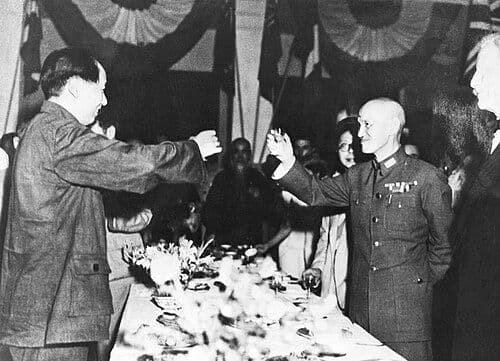
Mao had little expectation of a lasting agreement — his internal communications make clear he considered civil war inevitable — but he accepted the invitation to demonstrate the CCP's commitment to peace and to buy time for military consolidation. His arrival in Chongqing on 28 August was a public sensation; photographs of Mao and Chiang raising glasses together were reproduced across China.
The Negotiations and the Double Tenth Agreement
The forty-three days of talks were conducted largely through intermediaries. The core issues — integration of CCP troops into a national army, the status of Communist-controlled "liberated areas," and the composition of a future coalition government — remained unresolved. On the first two points no real agreement was reached; both sides made vague gestures at compromise while maintaining their actual positions. The Double Tenth Agreement, signed on 10 October, committed both parties to "long-term cooperation, resolutely avoiding civil war" and to convening a Political Consultative Conference. It was a framework of principles, not a binding operational agreement.
The Road to Civil War
The Political Consultative Conference convened in Chongqing in January 1946 and produced resolutions that, if implemented, might have established a genuine coalition. The KMT's Central Executive Committee rejected them in March 1946. Clashes between Nationalist and Communist forces — already ongoing since October 1945 — escalated through the spring, and on 26 June 1946, the Nationalist government launched a full-scale offensive against CCP positions. The civil war had resumed in earnest.
Narrative Comparison
| Source | Narrative |
|---|---|
| PRC Official Narrative | The Chongqing negotiations demonstrated the CCP's sincere commitment to peace and national unity. Mao Zedong travelled to Chongqing at personal risk, negotiating in good faith even as Nationalist forces continued military operations against Communist-held areas in northern China. The Double Tenth Agreement offered a genuine foundation for coalition government — it was the KMT's Central Executive Committee that destroyed it, rejecting the Political Consultative Conference resolutions and, with American logistical support, launching a full military offensive in June 1946. The civil war that followed was not chosen by the Communist Party; it was imposed by a Nationalist government unwilling to share political power and sustained by foreign intervention. |
| ROC / Taiwan Narrative | The Republic of China government signed the Double Tenth Agreement in good faith, as a genuine framework for peaceful reconstruction under a constitutional national government. The Chinese Communist Party rendered it unworkable: it continued seizing Japanese-surrendered territory, refused to integrate its armies into a national command structure, and maintained parallel administrations in occupied areas. When the KMT Central Executive Committee declined the Political Consultative Conference resolutions in March 1946, it did so because those resolutions would have granted the CCP institutional power with no basis in constitutional precedent. The National Government was the internationally recognised sovereign authority; what followed was not a civil war of equals, but a Soviet-backed armed rebellion against the legitimate constitutional order. |
| Western Academic Perspective | Both parties entered the Chongqing negotiations primarily to secure international legitimacy rather than to reach a workable power-sharing arrangement. Neither Mao nor Chiang believed the talks would succeed; both were simultaneously directing military operations to strengthen their positions before any agreement could take effect. The talks' failure was structural rather than personal: the CCP required territorial bases to survive as a political force, while the National Government required the CCP's disarmament to function as a sovereign state — conditions that were mutually exclusive. General George Marshall's subsequent mediation mission (December 1945 – January 1947) extended the negotiating framework without resolving this underlying incompatibility. |
Key Milestones
- Mao arrives in Chongqing
Mao Zedong arrives in Chongqing to begin forty-three days of negotiations with Chiang Kai-shek.
- Double Tenth Agreement signed
KMT and CCP sign a framework agreement committing to peace and a Political Consultative Conference.
- Political Consultative Conference
All-party conference in Chongqing produces resolutions for a coalition government.
- KMT Rejects Political Consultative Conference Resolutions
The KMT Central Executive Committee votes to overturn the resolutions of the Political Consultative Conference, eliminating the basis for a coalition government and effectively ending the negotiating framework established at Chongqing.
- Full-scale civil war resumes
Nationalist government launches full-scale offensive against CCP positions; civil war resumes in earnest.
Last verified: